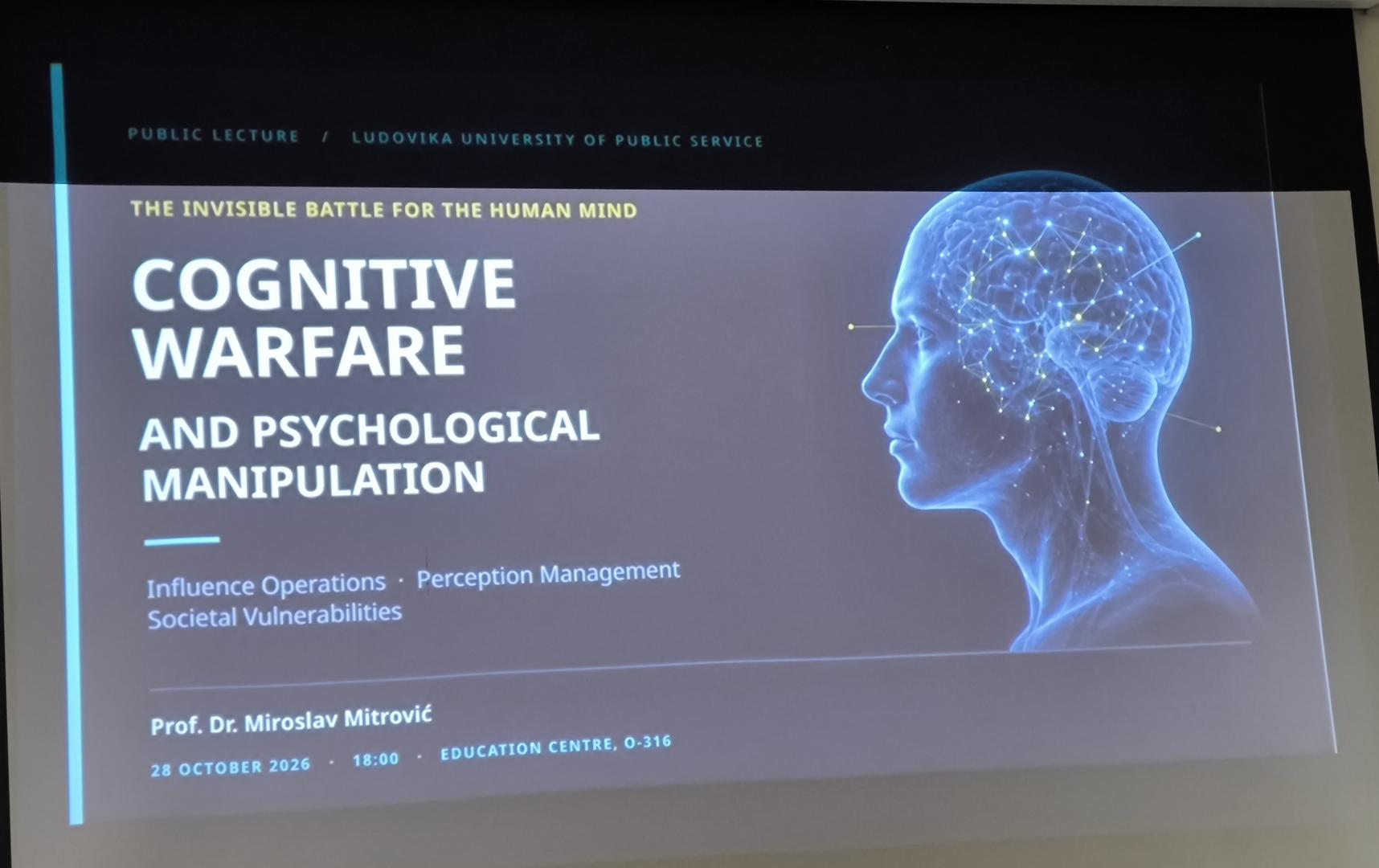
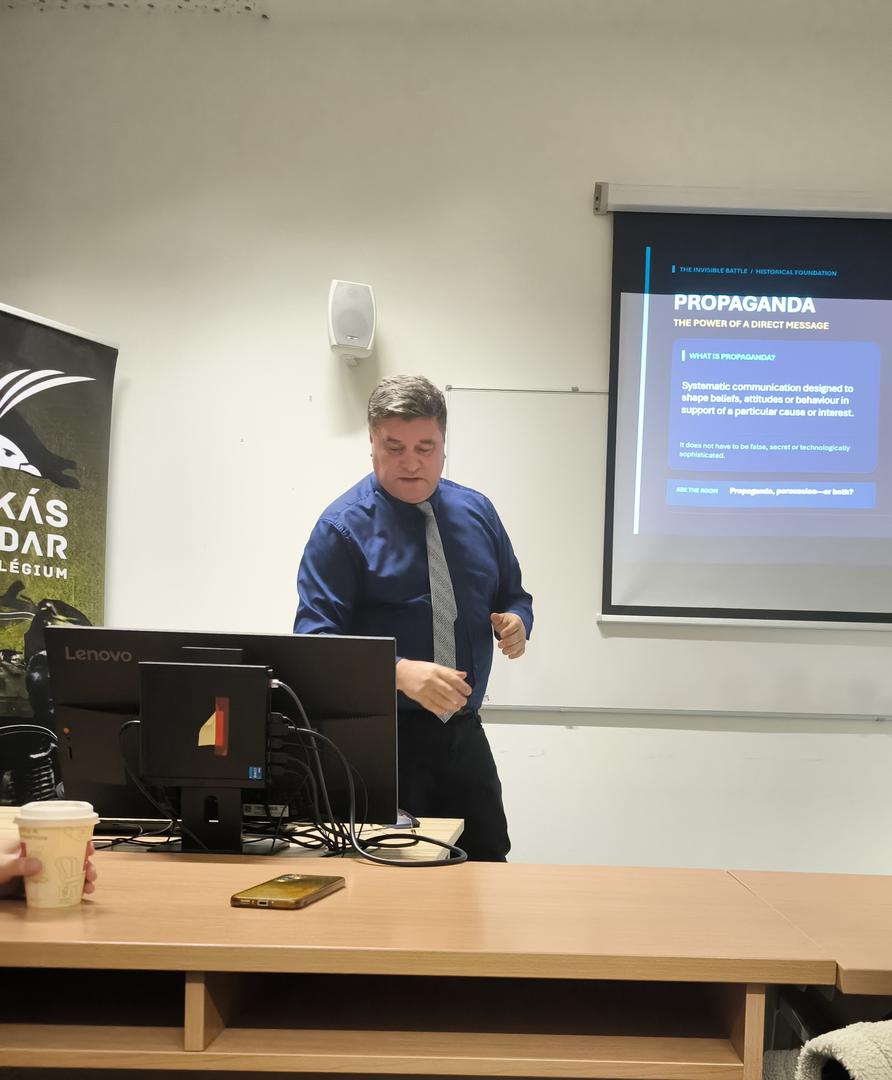
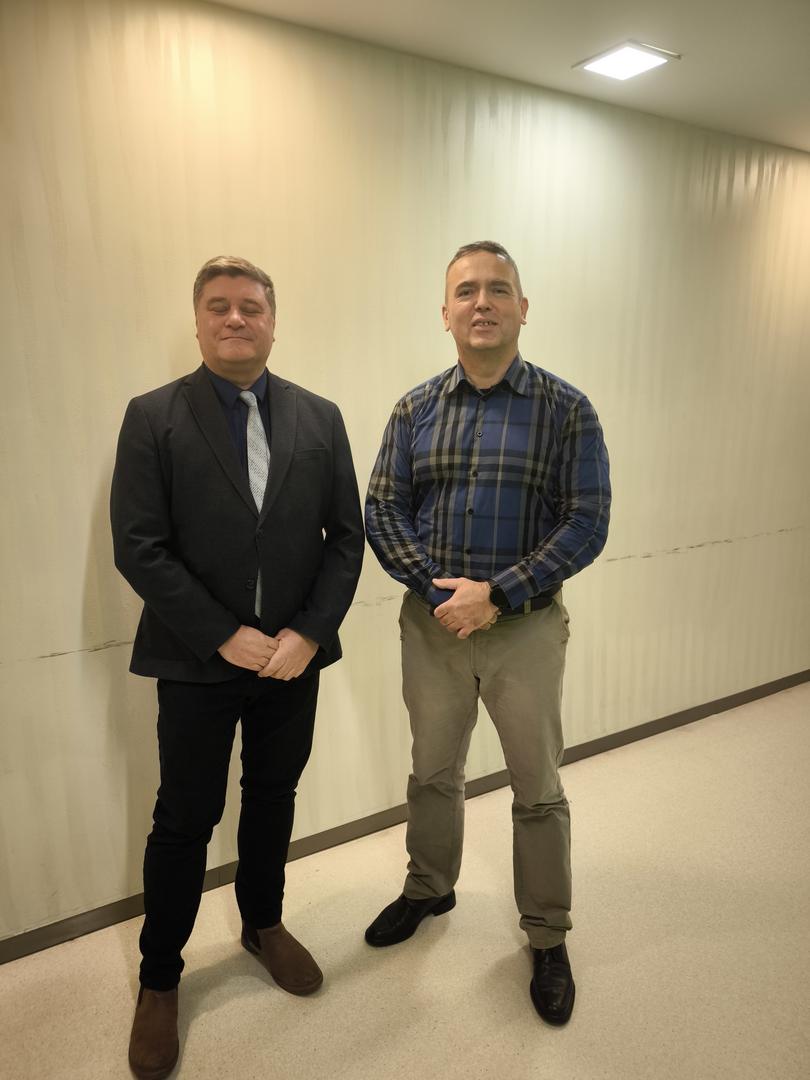
Associate Professor Dr Miroslav Mitrović, of the Faculty of Project and Innovation Management (PMC), Educons University, Serbia, and Senior Fellow at the Institute for National and International Security (INIS), Belgrade, delivered a public lecture on cognitive warfare, psychological manipulation and societal resilience at the Faculty of Military Science and Officer Training of Ludovika University of Public Service (FMSOT LUPS). A retired Colonel of the Serbian Armed Forces with 36 years of military service, Professor Mitrović is currently a Visiting Fellow under the Ludovika Fellowship Programme.
The lecture, titled‘Cognitive Warfare and Psychological Manipulation: Influence Operations, Perception Management, and Societal Vulnerabilities’, took place on 28 October 2026 in Room O-316 of the Education Building, drawing an audience of more than 50 attendees, including numerous students of international security and defence policy.
In his opening remarks, Professor Mitrović emphasised that cognitive warfare is characterised by relatively low operational costs and potentially significant strategic effects, enabling direct engagement with an adversary’s population and decision-makers. He underscored that whilst these operations are exceptionally extensive and impactful, assessing their actual influence on individuals, societies, and decision-making processes presents significant methodological challenges that make precise, universal quantification difficult.
During his theoretical overview, the speaker delineated fundamental concepts from a disciplinary perspective: he analysed the distinct characteristics of propaganda, persuasion, marketing, manipulative communications, public relations, and advertising, addressing the specific operational mechanics of false context. As an illustrative historical vignette, he referenced Pharaoh Ramesses II and the Battle of Kadesh, regarded as one of history's earliest examples of state propaganda whose narrative persisted across millennia. He subsequently examined the concepts of soft and sharp power, as well as the doctrinal utility of psychological operations (PSYOPS) through the operational lessons of the Vietnam War and the Gulf War, whilst further detailing the capabilities inherent in perception management, influence operations, and coordinated messaging.
Examining modern information warfare, Professor Mitrović addressed the mechanisms of foreign information manipulation and interference (FIMI). He provided a detailed assessment of contemporary information manipulation tactics, including the Doppelgänger campaign—designed to mislead public opinion through the spoofing and cloning of authoritative news outlets—as well as distinct recent examples of targeted disinformation, such as the falsification of France 24 television graphics and programming during the 2024 Paris Olympic Games. Furthermore, he outlined the psychological dynamics underpinning confirmation bias, selective attention, the illusory truth effect, and moral omission, emphasising that contemporary algorithmic architectures facilitate the most rapid digital dissemination for emotionally charged, grievance-driven narratives.
The structured process of narrative manipulation was framed through the successive phases of framing, seeding, ranking, and repetition. As a supplementary illustration, Professor Mitrović referred to recent bomb threats against educational institutions in Hungary to highlight the cognitive and psychological dimensions of crisis situations, particularly how uncertainty, fear and perceived threats can influence individual and collective responses.
Concluding the lecture, Professor Mitrović placed major emphasis on the fundamental pillars of cognitive resilience: the cultivation of critical thinking, media literacy, independent source verification, institutional transparency, public trust, and the preservation of autonomous decision-making. Within this broader framework, he highlighted practical steps for strengthening individual and collective resilience, including the consultation of verified counter-disinformation platforms (such as EUvsDisinfo / Disinfo Review), disciplined source criticism to mitigate synthetic panic, and the prudent, responsible use of digital technologies alongside direct interpersonal engagement.
Text: FMSOT LUPS
Photo: FMSOT LUPS Archive