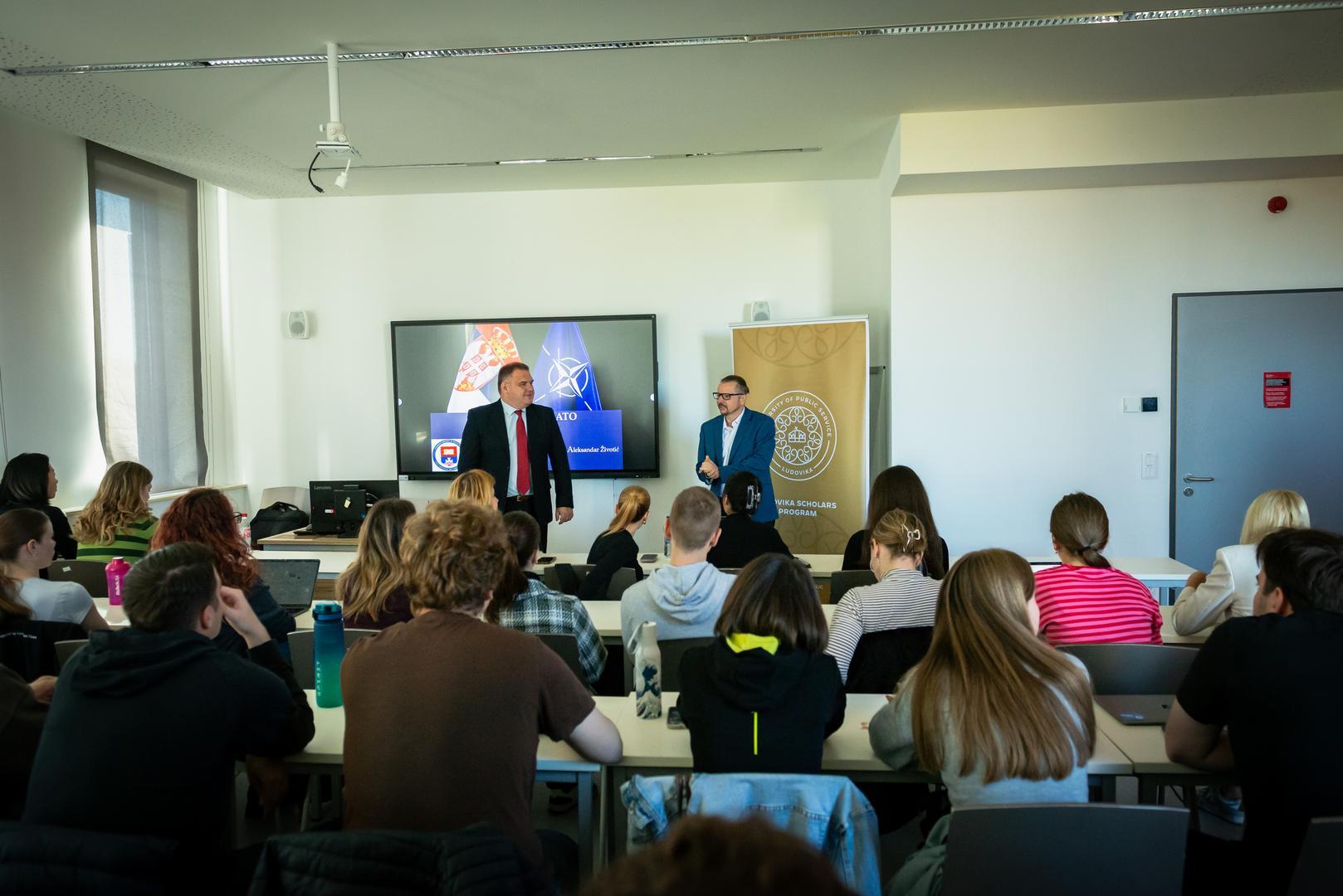
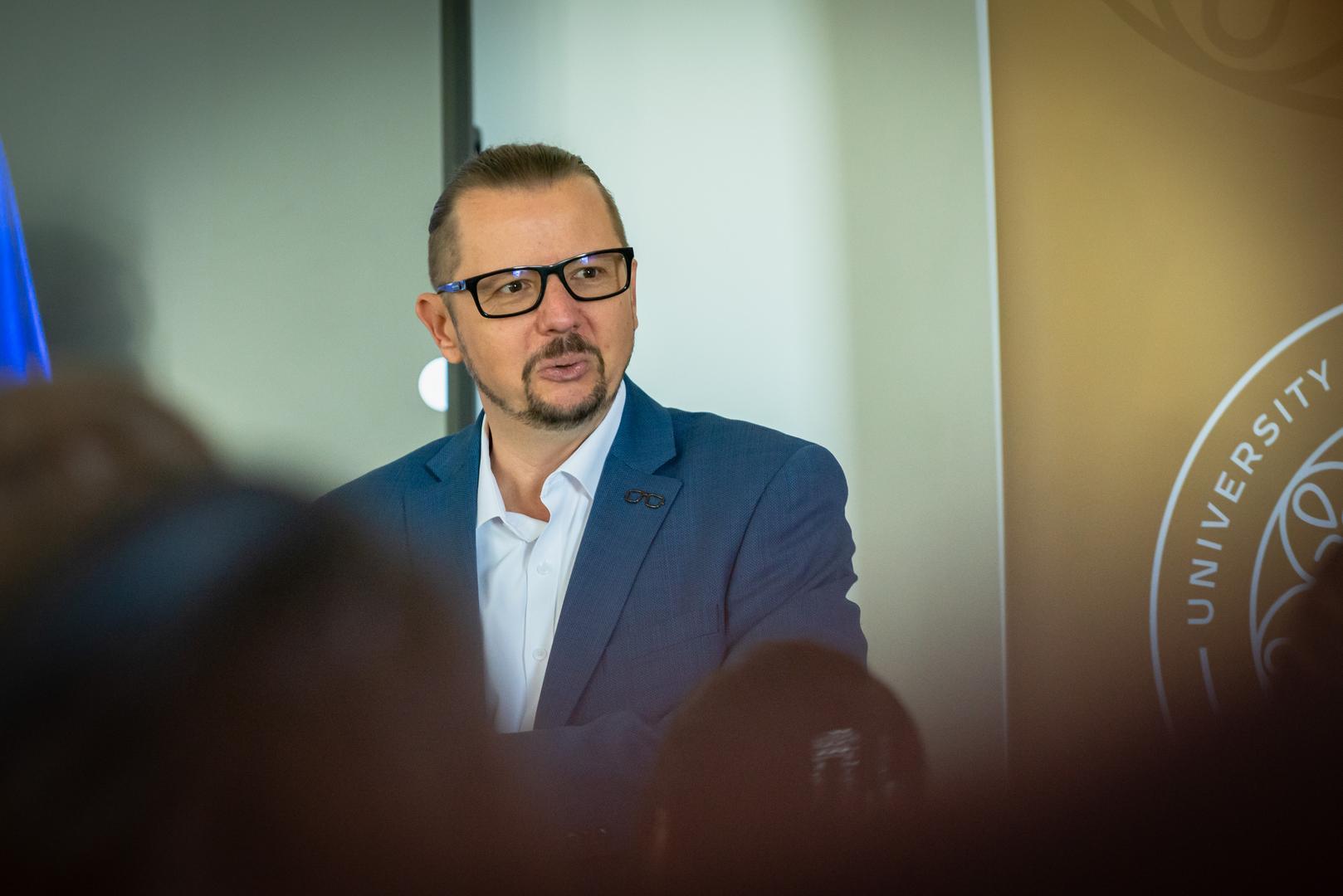
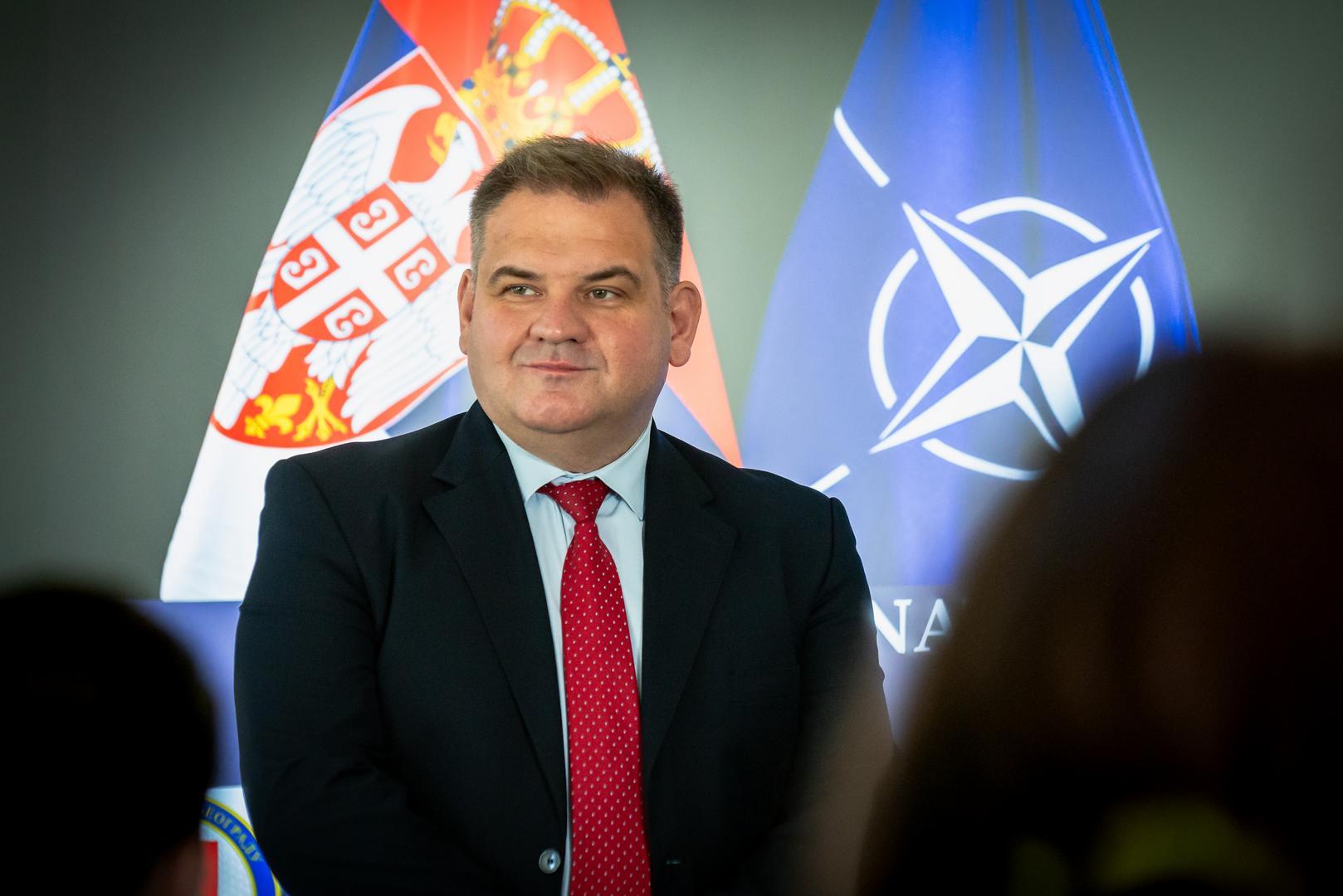
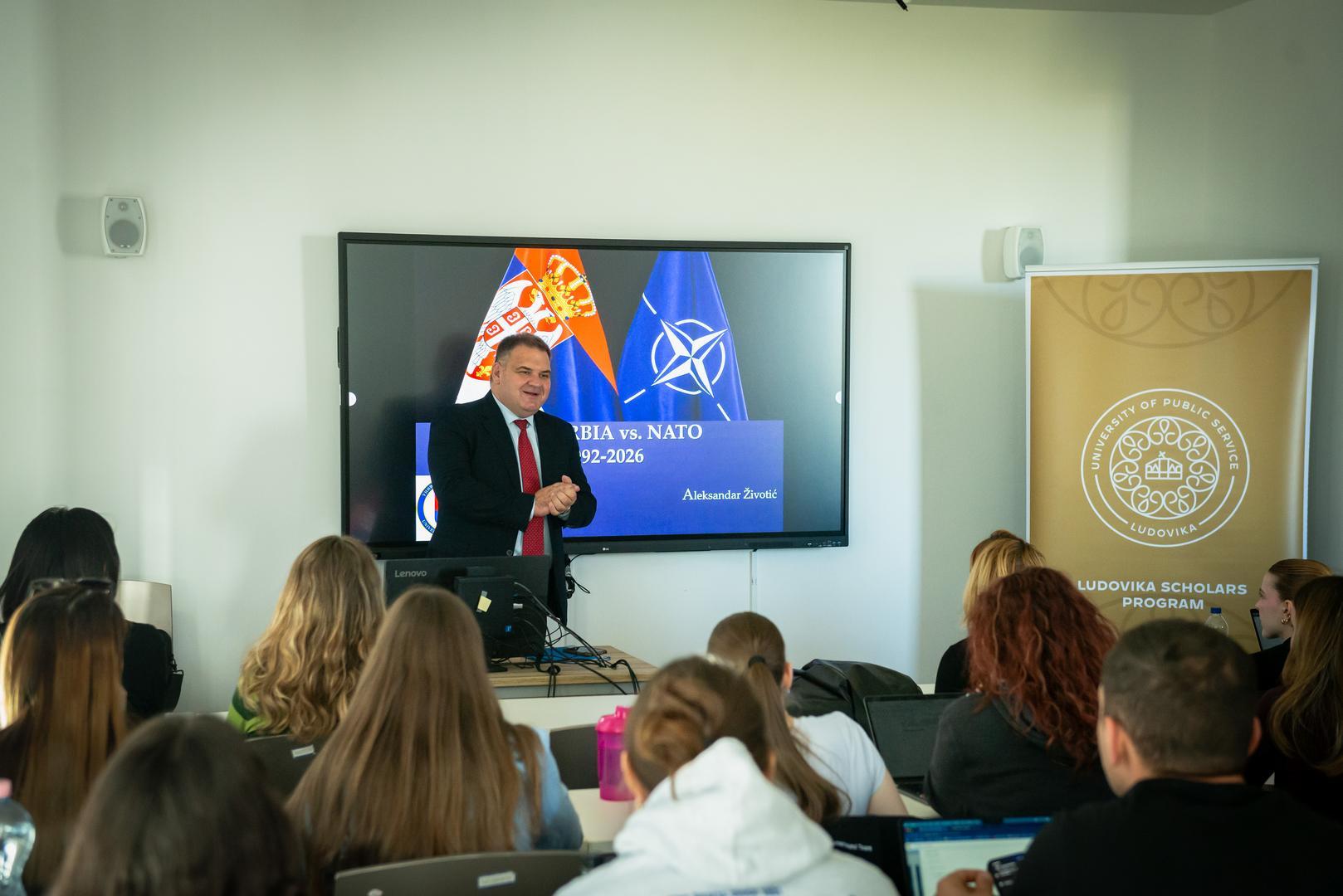

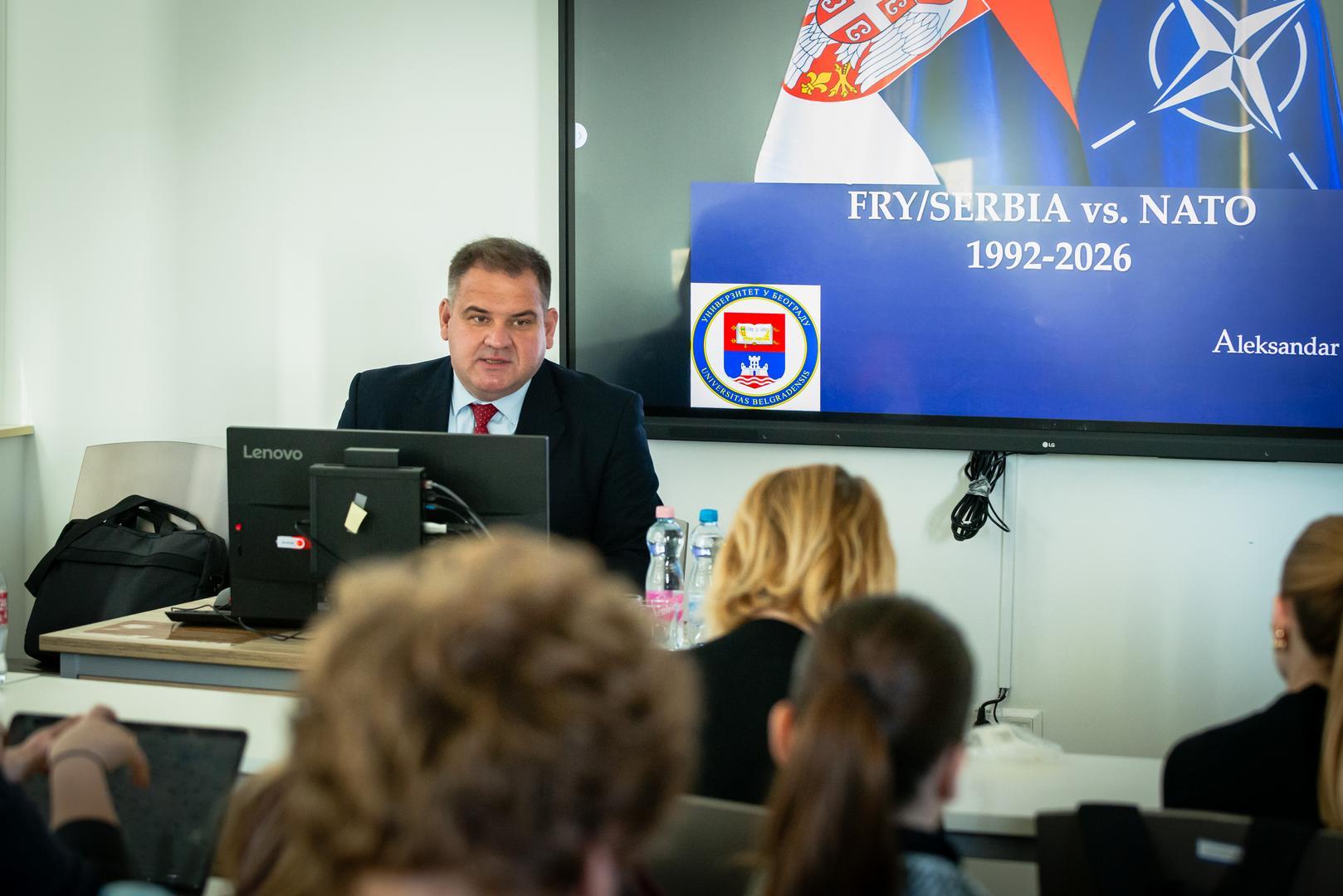

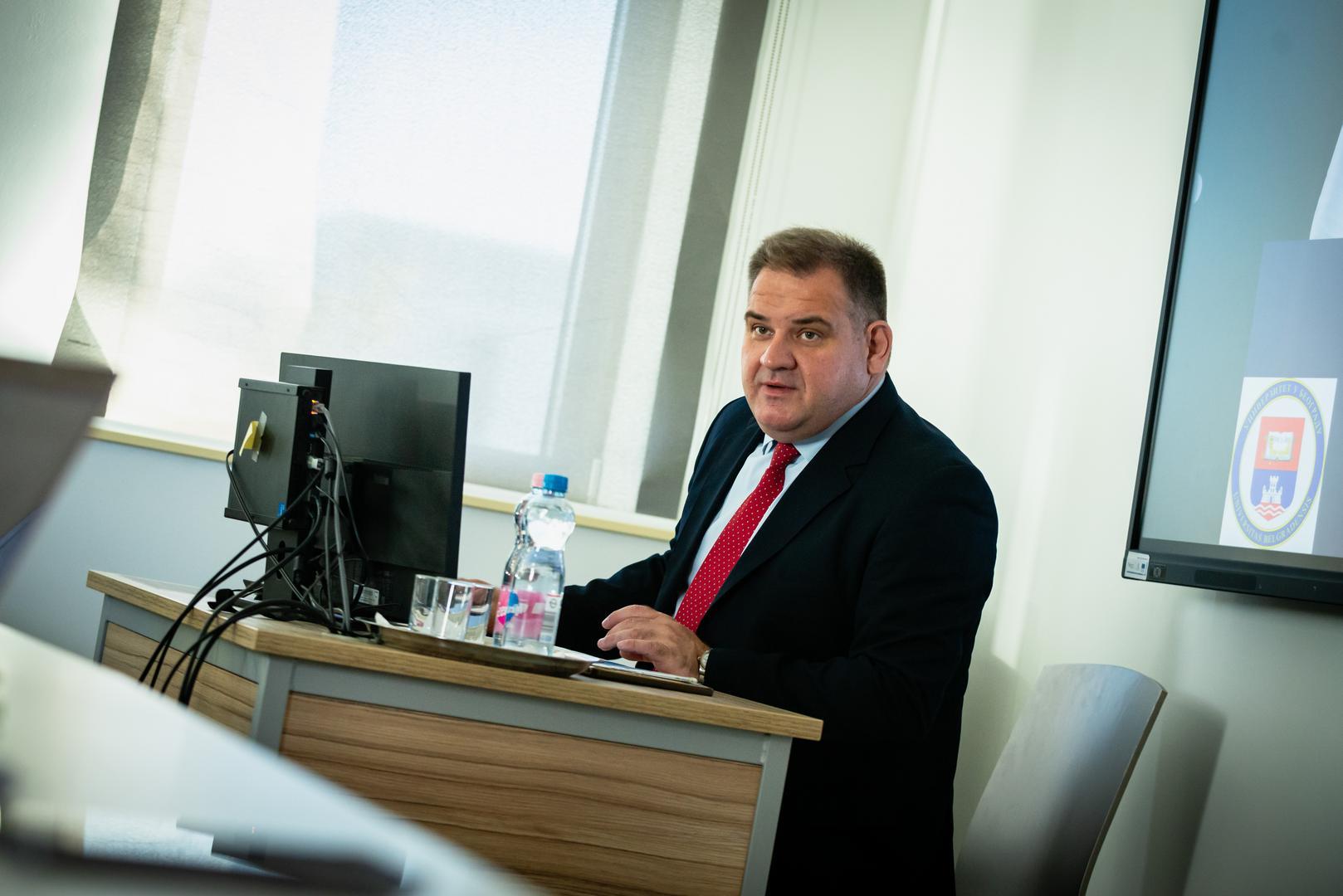



Aleksandar Životić, Head of the Department of History of Yugoslavia at the University of Belgrade, gave a lecture on the stormy and conflictual relationship between Serbia and NATO at the Ludovika University of Public Service.
Organized by the John Lukacs Institute (JLI) of LUPS within the framework of the Ludovika Scholars Program, the Serbian transatlantic expert gave a lecture in the university's Education Centre, outlining the multi-decade sequence of events in Serbian–NATO relations before a large audience.
Aleksandar Životić began by outlining the antecedents: he took the end of World War II as the origin, then laid down that between 1945 and 1948 Yugoslavia "maintained a special relationship with the Soviet Union and was one of the strong pillars of the Soviet bloc."
In 1948, the Yugoslav–Soviet conflict became known to the broader international public as well; Belgrade rejected the Soviet model, and with this policy of pursuing its own path, it found itself in a vacuum in the international political arena, while its weakened economy began seeking American support instead of Soviet aid. By the early 1950s, the outcome of the Chinese Civil War and the developments of the outbreak of the Korean War created a new geopolitical situation, and Yugoslavia began orienting towards the West.
Aleksandar Životić said that Yugoslav diplomats negotiated with American military leaders in 1951, primarily on military cooperation, a tangible result of which was that between 1952 and 1957 Western military and economic aid arrived in the Balkan state, namely tactical equipment and food shipments. Later, the preparation of NATO accession and the potential integration of Serbia into the military alliance were also discussed; the Turkish–Serbian negotiations starting in 1952 bore fruit a year later, resulting in the Turkish–Greek–Serbian agreement on military cooperation, the so-called Balkan Pact.
According to the speaker, Yugoslav integration would have provided operational space for the West on the border of the Soviet sphere of influence, and Yugoslavia could have formed a kind of buffer zone along the Iron Curtain during the heating-up period of the Cold War.
The normalization of Yugoslav–Soviet relations became possible after Stalin's death, but Yugoslavia did not join the Warsaw Pact, while with NATO it only reached partnership, as Belgrade chose the principle of neutrality for itself.
Serbian–NATO relations are closely linked to the breakup of Yugoslavia: in 1991, Slovenia and Croatia declared independence, and a year later Macedonia and Bosnia and Herzegovina did the same – in the case of the latter, however, Bosnian Serb forces launched an offensive and reclaimed territories under Serbian control at the cost of bloody clashes.
NATO spoke out for the first time regarding the Balkan war at this point: it asked the opposing parties to allow UN peacekeeping troops into the area. On the other hand, in November 1992, in order to enforce the UN Security Council resolution on the maritime embargo and to monitor sea routes, NATO units arrived in the Adriatic, their ships monitored waters off Montenegro, and they inspected cargo bound for Yugoslavia in international waters. Between 1993 and 1996, NATO kept Yugoslavia's coastline under a naval blockade, while from 1992 NATO aircraft introduced a no-fly zone over the country based on UN Security Council Resolution 781, and flying into no-fly zones was prohibited.
The Serbian expert called attention to the fact that from February 1994, NATO's participation became increasingly strong in the region; indeed, the first active military clash in NATO's history took place: four Serbian fighter jets were shot down over Banja Luka, and later, in 1995, Bosnian Serb forces brought down an American NATO aircraft with a missile. The final spark was provided in July 1995 by the Bosnian Serb attack on Srebrenica; NATO decided on military intervention, and when Bosnian Serb forces bombed the Sarajevo market at the end of August, NATO actually began targeted bombing of Bosnian Serb forces.
The Bosnian War was finally concluded by the Dayton Agreement in November 1995; part of the agreement was that NATO would provide 60,000 troops within the framework of IFOR forces to guarantee security in the region.
Even so, in 1998, the Balkan conflict erupted again: Western powers decided on military intervention following the collapse of the Rambouillet negotiations, accusing the Serbian side of carrying out brutal attacks against Albanians. Between March and June, NATO bombed Yugoslav forces, doing so in a way that the United States, fearing a Russian and Chinese veto in the Security Council, did not request UN authorization for the attack, and moreover decided without consulting the Allies. NATO's condition for stopping the airstrikes was the withdrawal of Serbian forces from Kosovo, and that the stabilization of the situation be resolved by the stationing of NATO-led KFOR forces and UN peacekeepers there.
"Assessing Serbia's potential NATO membership is problematic among the Serbian population: due to the NATO bombings, the majority of Serbian society is skeptical towards NATO, while at the state level institutional relations between Serbia and NATO are excellent," Aleksandar Životić explained, adding that over the past quarter-century significant rapprochement has taken place between the two entities: in 2003 Serbia and Montenegro applied for NATO's Partnership for Peace Program, in 2006 they were admitted, in 2011 consultations began with NATO's cooperation called the Individual Partnership Action Plan, which was followed by an agreement in 2015, then a military representation office opened at Serbia's NATO representation, and in 2026 the first joint Serbian–NATO military exercise was held at Borovac with the participation of 600 Serbian soldiers.
At the end of his lecture, answering a question, the Serbian expert said: Russian influence was not strong in Serbia in the 1990s, but in the last 5–10 years this has noticeably changed, especially in the media, and the proliferation of pro-Russian content is most noticeable on social media platforms.
Text: Tamás Maráczi
Photo: Márk Benjámin Mészáros