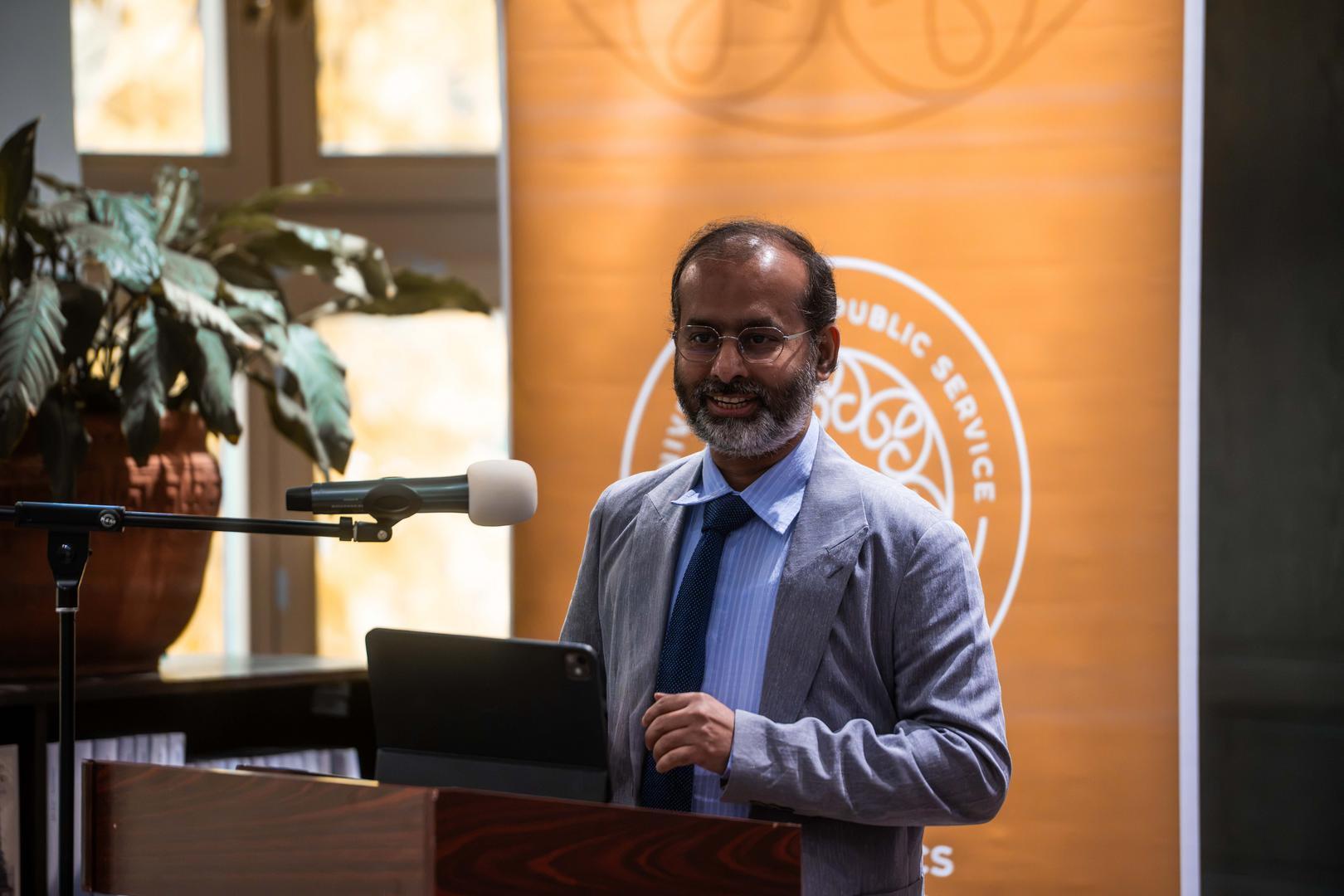
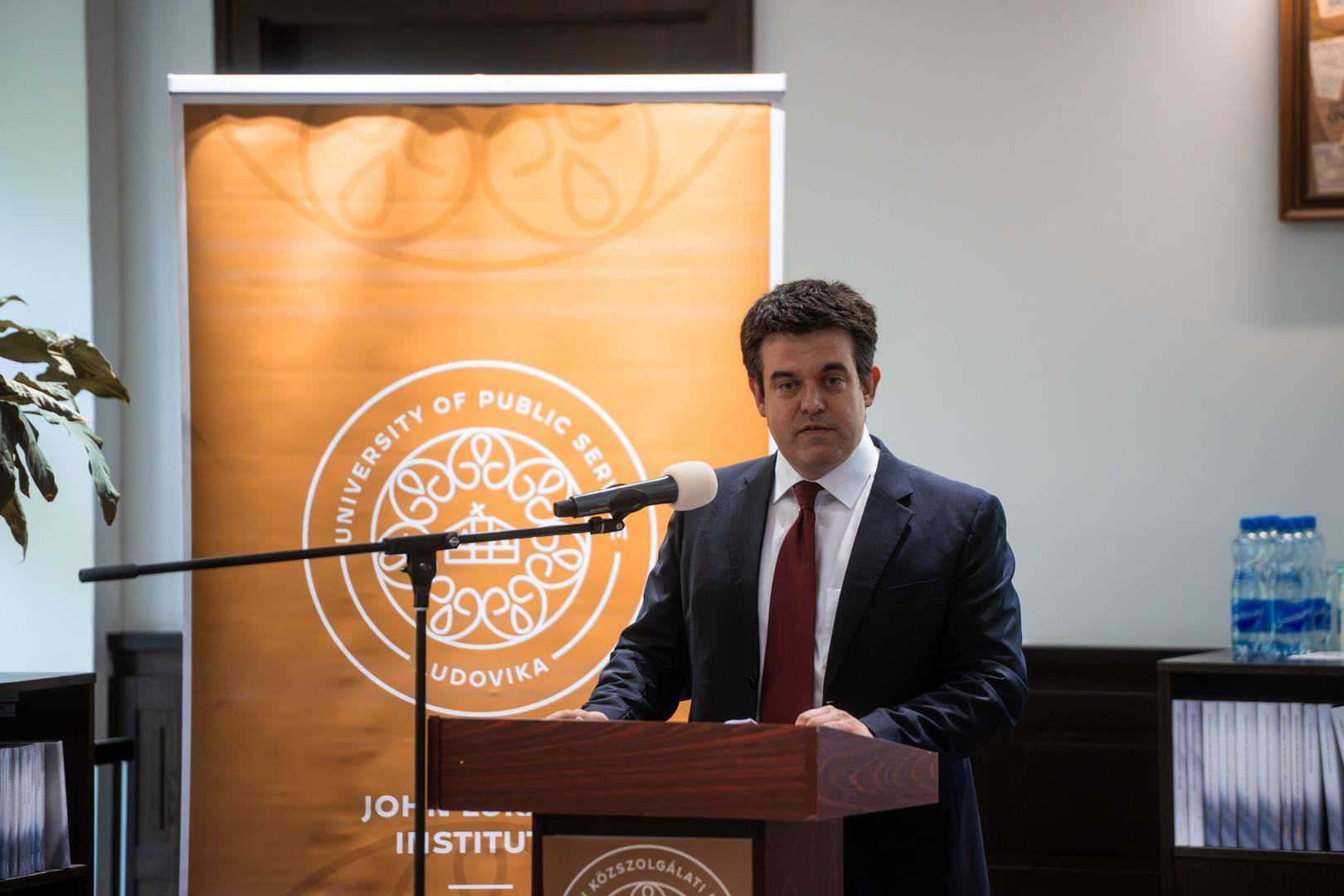



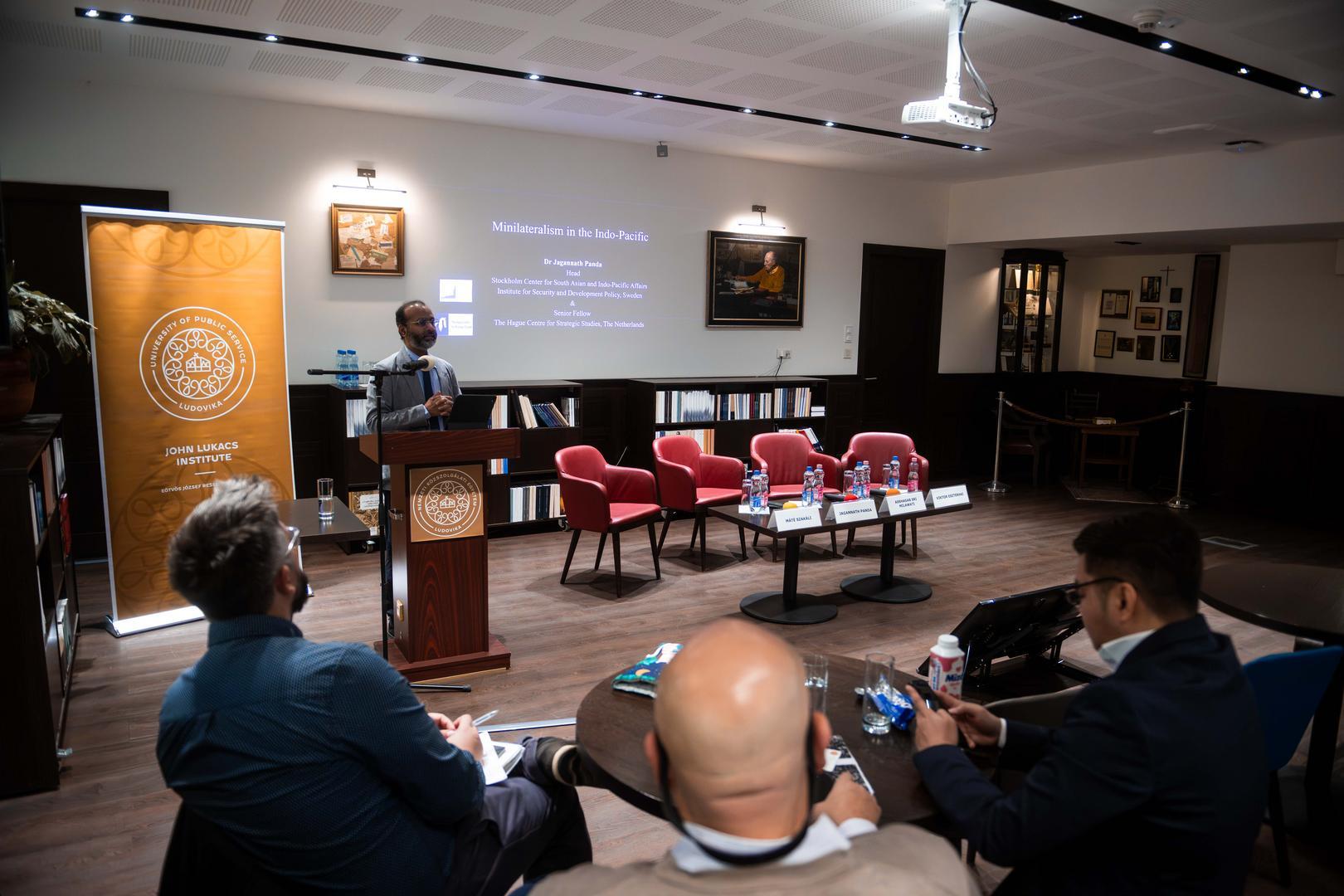

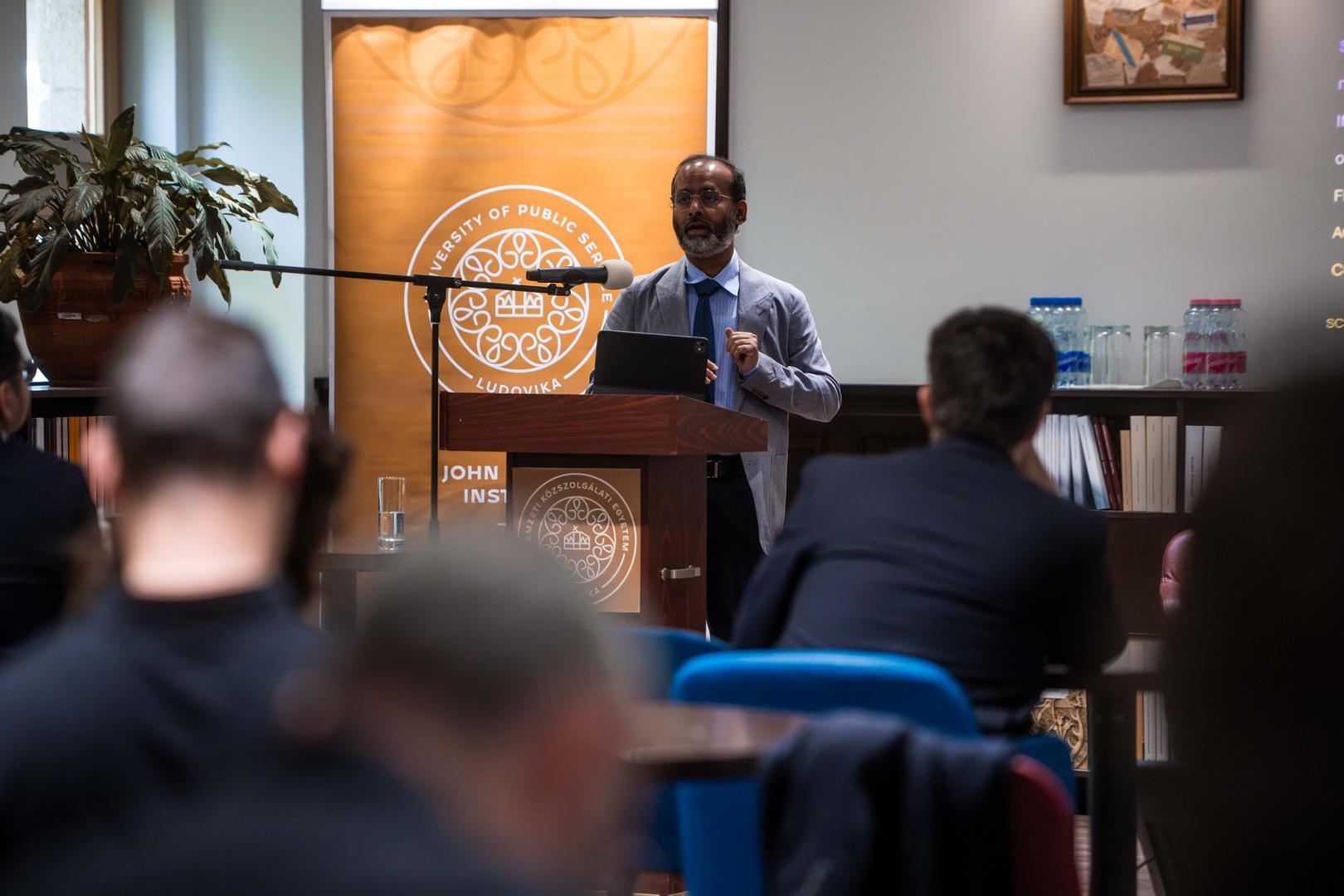

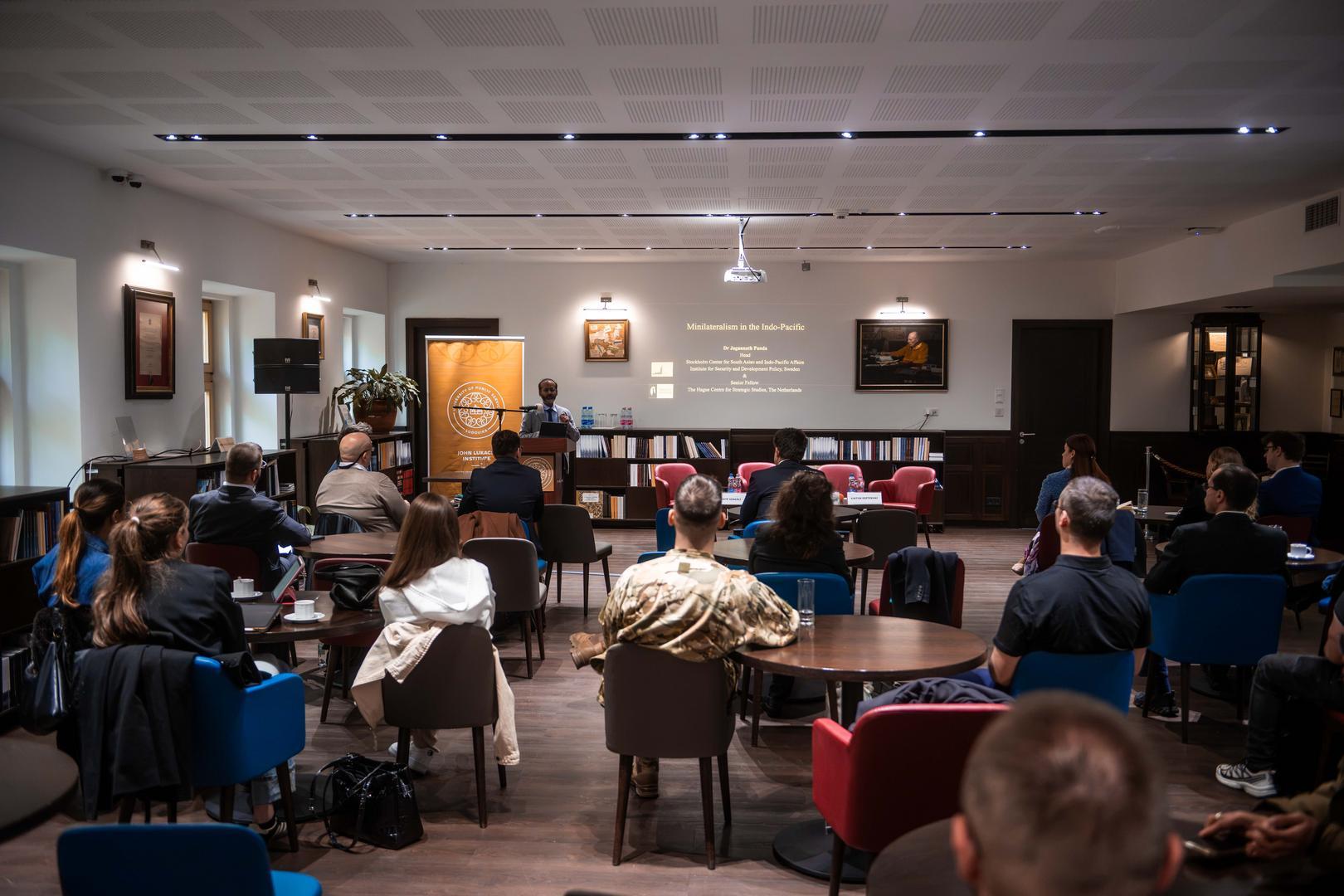
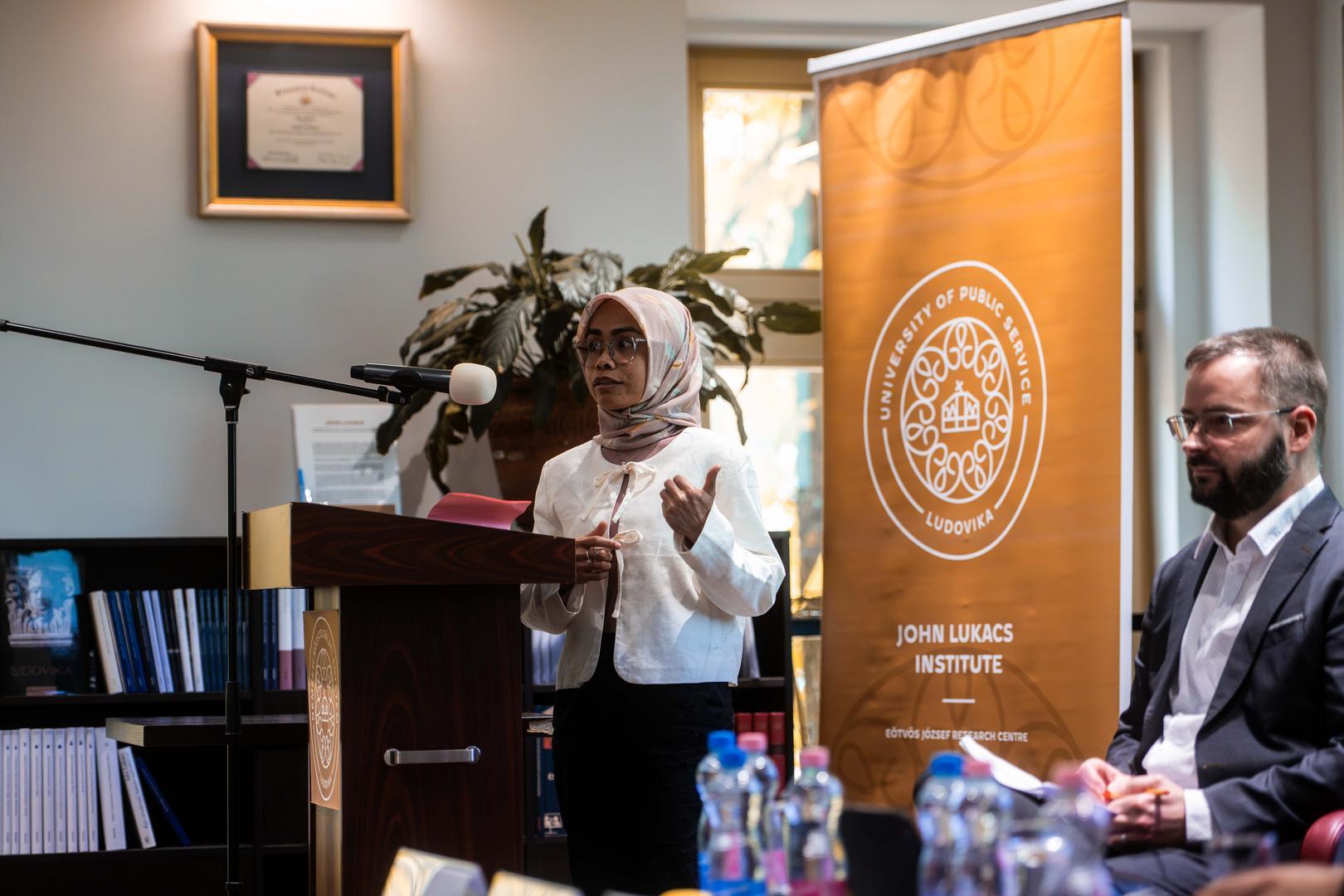

The Ludovika University of Public Service played host to a conference on the interest assertion strategies of small and medium powers in the Pacific region, organized by the John Lukacs Institute (JLI) of the Eötvös József Research Centre (EJRC) on October 20, in the John Lukacs Lounge.
The international audience was welcomed by Viktor Eszterhai, Research Fellow at the institute, and Pier Paolo Pigozzi, Vice-Rector for International Affairs at the university; in his introductory remarks, the latter stated: the target group of the conference is the countries of the Pacific region; their diplomacy is currently determined by multilateral relations, but in the future minilateralism may gain increasingly greater ground.
What is minilateralism? The new technical term is already well known in professional circles, but presumably less so for the general public. In his keynote presentation, the renowned Indian professor Jagannath Panda undertook the task of presenting this phenomenon, and he provided the short description: it is the goal-driven, task-specific, and informal cooperation of three or four states.
In the interest of efficiency and rapid decision-making, the states organizing among themselves seek to solve specific strategic issues after defining them, outside of a multilateral, institutional framework. According to the head of the Pacific research institute of the Stockholm-based Institute for Security and Development Policy (ISDP), minilateralism is not a passing diplomatic fad, but already a fundamental form of cooperation in the region.
According to the India expert, the international environment demands this forum; the American–Chinese strategic rivalry, the war in Ukraine, the Taiwan question, and the Indian–Pakistani and Indian–Chinese border disputes are difficult-to-manage issues, while international diplomacy is "paralyzed" at the multilateral level: there is no agreement among the members of the UN Security Council on major geopolitical questions, major regulatory debates are taking place in the WTO, and in regional organizations such as ASEAN in the region, there is no effective problem management, only dialogue—in short: there is no effective institutional functioning.
Stepping in to replace this are smaller cooperations, such as "the informal Quad, the treaty-based AUKUS, or the project-oriented I2U2," the speaker continued, adding that these are created by a "coalition of the willing" (that is, several countries open to an informal form of cooperation), and ad hoc cooperation does not create obligations, but rather a kind of partnership.
Jagannath Panda called attention to the fact that not all such groupings are ideologically driven; there are also pragmatic, project-focused cooperations, even between authoritarian and democratic states, since their goal is not for states with identical values to form an alliance, but to solve a specific shared problem as quickly and effectively as possible.
The professor cited the example of his own home country: India is a neutral country in a bridge-building position, rejecting thinking in interest groups and blocs, and while its main goal is to maintain its own strategic autonomy, it concludes a series of functional cooperations. According to Jagannath Panda, based on this logic, it must also be avoided that cooperations between the Pacific region and Western states take on an anti-Chinese edge; instead, they should be practical cooperations, primarily with commercial content.
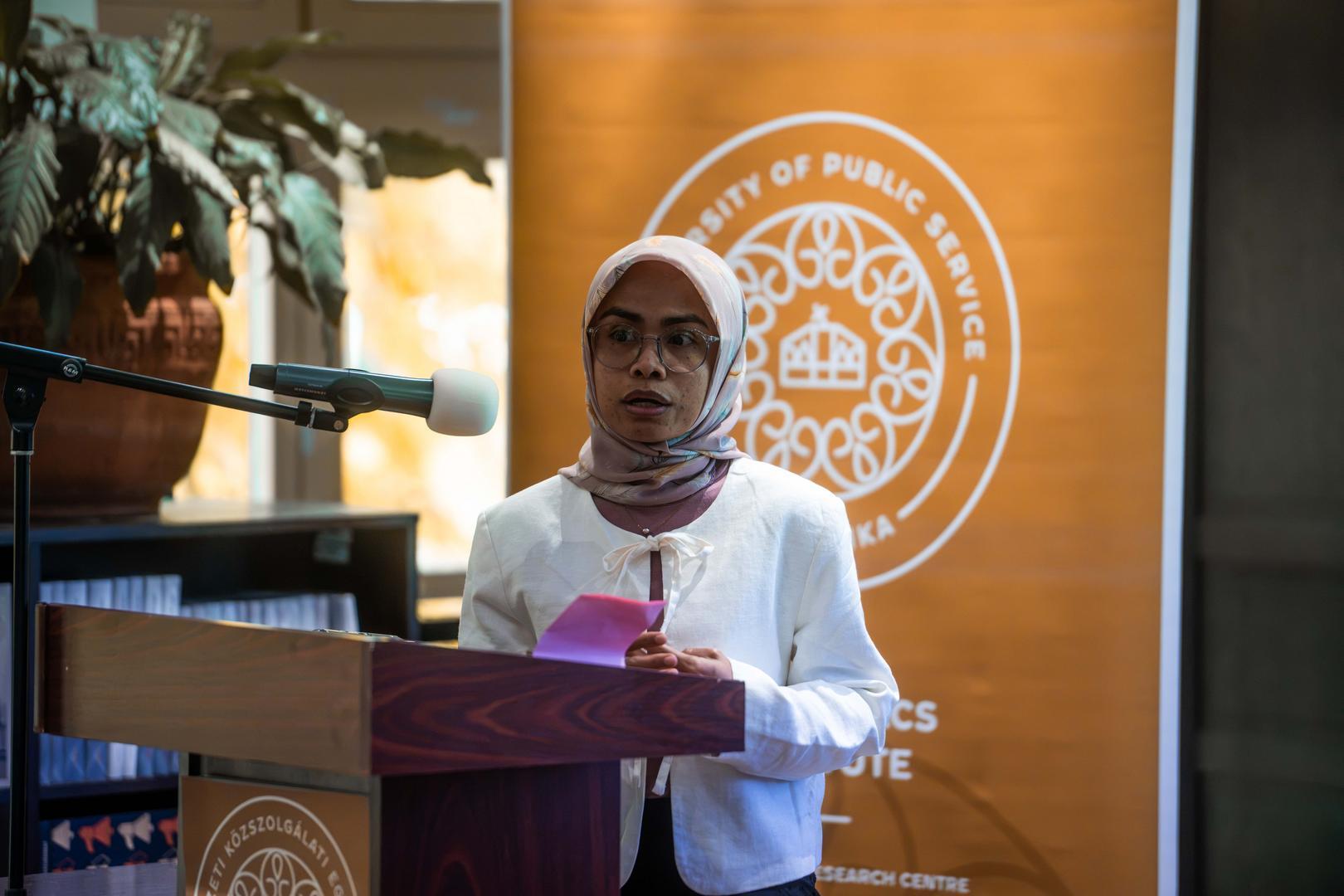
In the panel discussion following the opening presentation, Sri Milawati Asshagab, a PhD student at Corvinus University of Budapest, outlined the structure and forms of dozens of regional cooperations in the Pacific region, emphasizing that small states must learn that they need to work on what they can do for themselves instead of waiting for what others will do for them. As she said, the chance for small states lies in cooperating with their partners and jointly representing their own interests.
Máté Szakáli, researcher at the Doctoral School of History at ELTE, considered that the advantage of minilateralism can be focusing on narrowed topics and focused decision-making, which can be particularly effective in areas such as energy or disaster management. The less identity politics involved, the more result-oriented the outcome of decisions can be, he added.
Following this, Ann Bajo, PhD student and defense analyst at the University of Portsmouth, outlined the federal relations and chronological history of her home country, the Philippines, via online connection. It became clear from the presentation that the Pacific island nation has been under the protection of a defense treaty concluded with the Americans since 1951, but cooperation with them has been fluctuating. In the mid-1990s, public sentiment in the Philippines turned anti-American, with talk of American colonization, and then when America withdrew troops from there, China occupied a coral reef at the Spratly Islands, thereby introducing a new threat.
Today, the American–Chinese geopolitical strategic rivalry impacts all areas of life, Bajo continued her presentation; the Philippines wants to preserve its strategic autonomy and counterbalance growing Chinese influence, but does not want to fall into dependence on the United States either. Episodes of this delicate maneuvering were the "hard balancing" policy of the Aquino government, the Chinese rapprochement of the Duterte government, and then the balanced foreign policy and equal distance from both China and the United States maintained by the Marcos government. In her closing remarks, the speaker emphasized that small Pacific states must not get trapped in the conflict between major regional powers and must not remain passive.
In the second and final discussion of the conference, Danilo Lorenzo Delos Santos, PhD student at the University of Pécs, called attention to the fact that the Pacific region is now more important to America and the West than ever before: here are the semiconductor resources (Taiwan), the supplies for the technology industry, and a portion of rare earth metals, which is why they must remain connected to this region for economic and defense policy reasons. The researcher also reminded that ASEAN is not a monolithic organization, as its member states have unique state interests.
According to the Senior Research Fellow at the Eurasia Center of John von Neumann University, minilateralism can be a suitable form for small countries to participate in shaping major decisions in the 21st century. Péter Klemensits emphasized: American–Chinese rivalry affects ASEAN countries in different ways; in terms of security they rely on American support due to the Chinese threat, while in the field of economy they also have a lot to lose, as both America and China are important economic partners for them, and they do not want either of their revenue sources to be jeopardized because of the other.
Text: Tamás Maráczi
Photo: Dénes Szilágyi