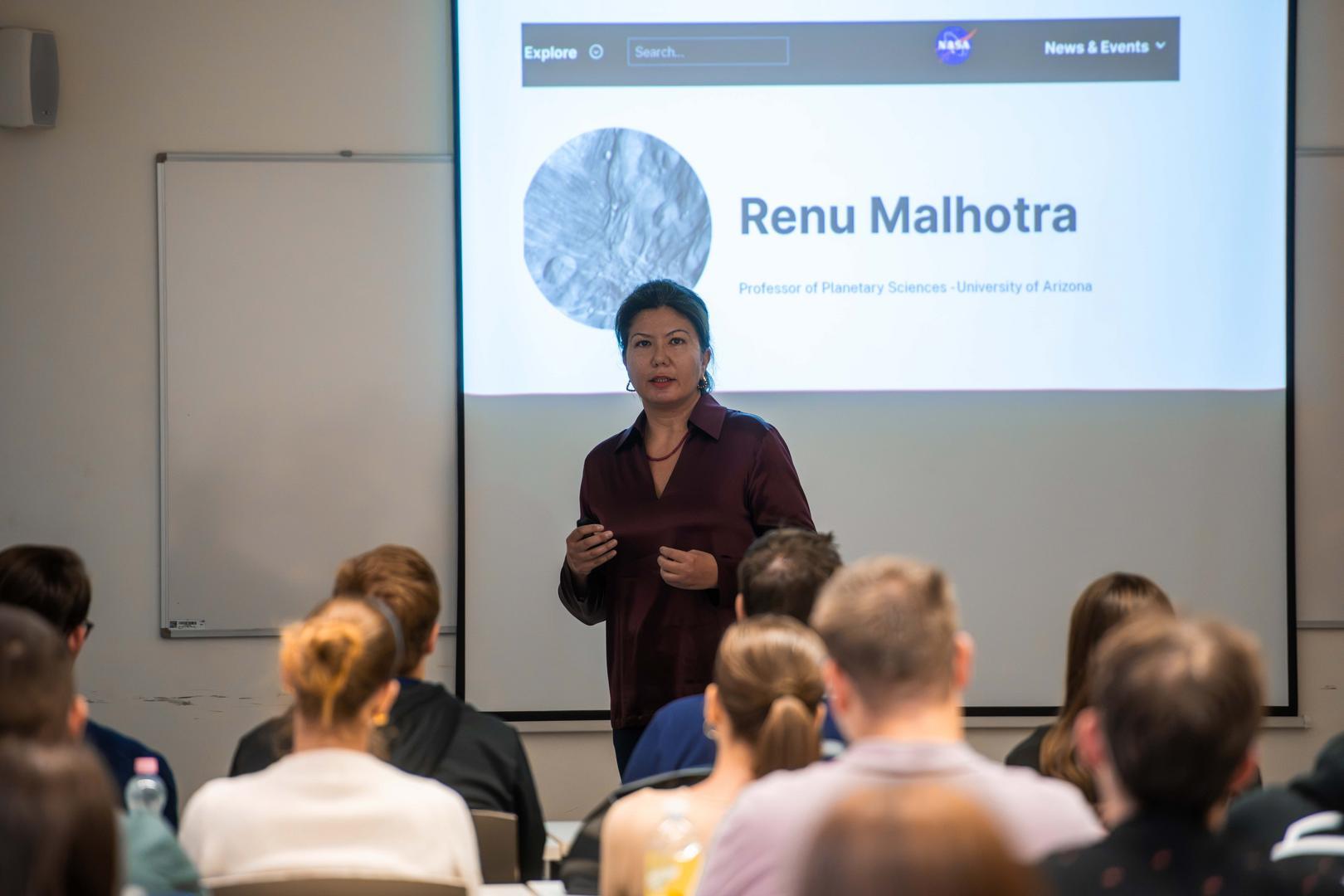


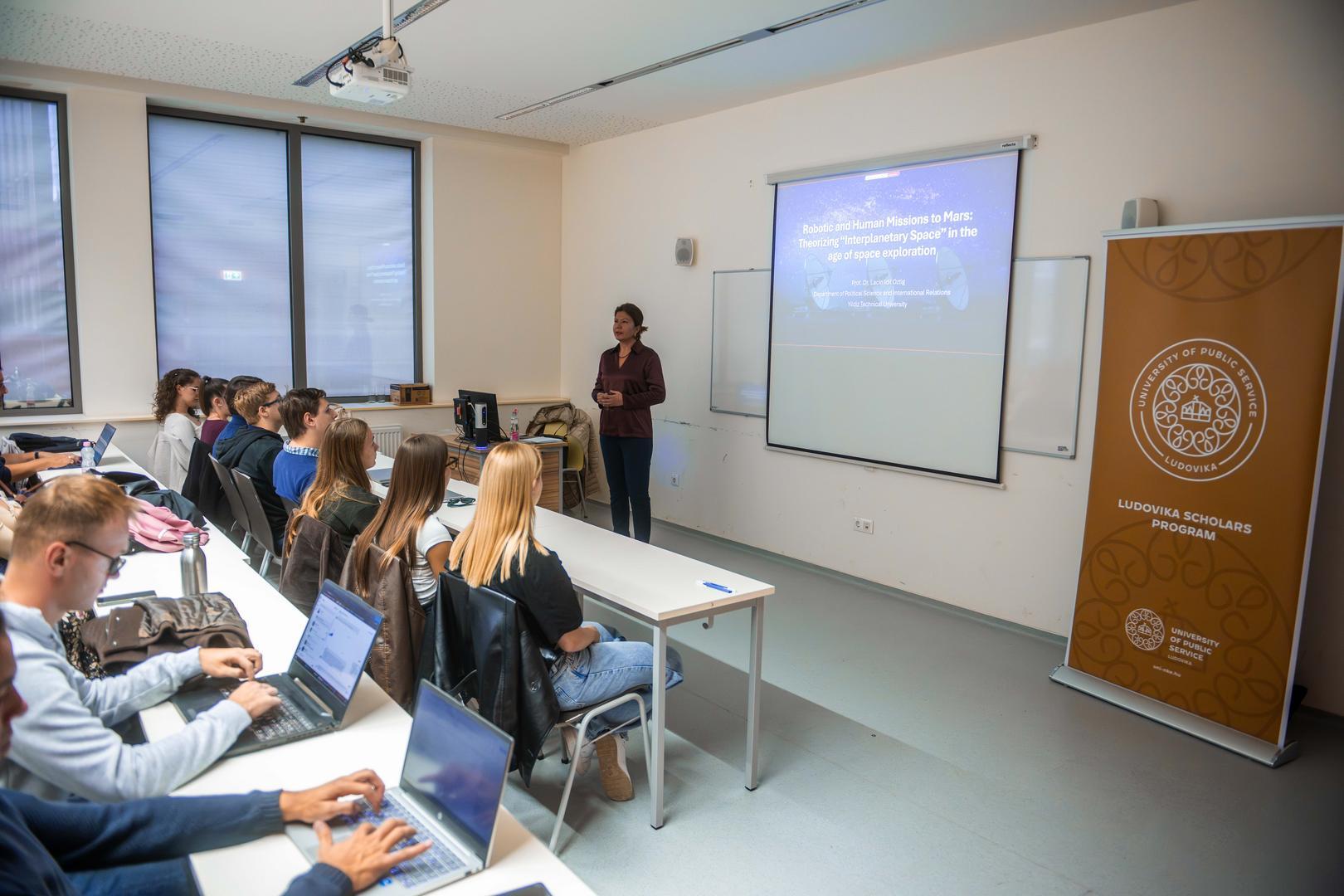




When we imagine human voyages to Mars, we usually think of roaring rocket boosters, autonomous rover telemetry, or the search for ancient microbial fossils. Yet as humanity stands on the precipice of deep space travel, the most pressing questions are no longer confined to orbital mechanics and aerospace engineering—they are deeply political, legal, and sociological. During her lecture at Ludovika – University of Public visiting professor Laçin İdil Öztiğ (Yıldız Technical University and University of Arizona) examined how Martian exploration is radically dismantling our traditional notions of space, power, and sovereignty in Service in the framework of the Ludovika Scholars Program.
From Terrestrial Borderlines to Vertical Geopolitics
Professor Öztiğ originally built her academic career researching territorial borders and border management on Earth. Inspired by American researcher Renu Malhotra, she began applying those same conceptual frameworks to outer space. The vast expanse between Earth and Mars is not simply a vacuum of physics; it constitutes an entirely new social and political domain termed interplanetary space. Grappling with this domain requires multidimensional thinking that moves beyond Earth-centrism without detaching from social reality. This transition has catalyzed the emergence of vertical geopolitics, where political power operates simultaneously on planetary surfaces, above them in orbital pathways, and subterraneanly beneath them. Space is far from passive: it is an immaterial, ideologically charged environment shaped by human values and digital geography, which compresses immense physical separation into digital proximity. This paradigm shift is already giving rise to specialized fields of inquiry, including space geopolitics, space politics, space sociology, and space biology.
Reaching the Red Planet remains an immense physical test: At its closest orbital approach, Mars is 54.56 million kilometers away; a tenuous carbon dioxide atmosphere makes soft landings notoriously difficult; the lack of an intrinsic magnetic field and ozone layer exposes incoming missions to intense solar winds and cosmic radiation, compounded by low gravity and extreme weather conditions
Yet the legal and political landscape is just as treacherous as the terrain. A fundamental debate centers on international status: is Mars terra communis (a common heritage belonging to all humanity) or terra nullius (no man’s land, open to occupation and exploitation)? Much like the historical frontiers of the Americas or Antarctica, Mars represents a contested physical, economic, and political horizon where conventional spatial boundaries blur into hybrid configurations.
The Rise of Techno-Capitalism in Deep Space
While Martian reconnaissance was initiated decades ago by the Soviet Union, our daily view of the planet is now maintained by orbiters and rovers transmitting images, audio, and scientific datasets back to Deep Space Network antennas in California, Madrid, and Canberra with an eight-minute radio delay. Crucially, the post-Apollo era of state-led prestige exploration has transitioned into an aggressive entrepreneurial space race. Ambitious milestones have converged on the 2030s, a target decade shared by NASA, China, and commercial ventures alike. NASA’s Artemis IV mission aims to return humans to the lunar surface as a stepping stone toward Mars, followed by the establishment of a lunar base under Artemis V.
Simultaneously, commercial enterprises such as SpaceX, Blue Origin, and Virgin Galactic drive the momentum. SpaceX founder Elon Musk envisions Mars as a "New World," explicitly invoking historical analogies to the settlement of the Americas and aiming to construct a permanent, self-sustaining civilization. This drive is underpinned by civil society groups and existential survival rationales, echoing Stephen Hawking’s warnings about terrestrial natural catastrophes and paleontologist Henry Gee’s observation that Homo sapiens could face extinction within the next ten thousand years.
Engineering Habitability and Its Discontents
Transforming Mars into a viable habitat involves radical technological proposals: Pressurized agricultural greenhouses; Local electromagnetic generators to compensate for the missing magnetosphere; Nuclear-propelled rockets designed for large-scale terraforming—an idea tracing its lineage back to Carl Sagan's early proposals to alter Venus’s atmosphere with microorganisms.
However, this vision of Mars as an instrument for human expansion – a form of techno-capitalism and political terraforming – faces substantial pushback. Critics argue that the collective future of interplanetary exploration is being disproportionately steered by a small circle of corporate billionaires rather than the democratic interests of Earth’s population. In response, alternative critical frameworks are emerging, including ecological, feminist, and Indigenous perspectives that question unrestrained resource colonization.
Deep Past, Deep Future, and the Questions Ahead
Through accessible NASA orbital maps and immersive VR simulations, digital tools manufacture a sense of everyday intimacy with a planet that remains lethally remote. In this sense, Mars functions as a philosophical mirror. The Deep Past means that its preserved geology offers vital clues about the origins of life and planetary evolution. The Deep Future means that it challenges humanity to contemplate multi-million-year civilizational horizons, even though contemporary governance lacks the political mechanisms to manage such timescales.
As the race toward the 2030s accelerates, the defining geopolitical questions remain unresolved: How will major spacefaring powers like the United States, China, and India calibrate their competing strategic interests on the Red Planet, and will the conquest of interplanetary space unfold under democratic or autocratic models
Text: FPGIS International Division
Photos: Dénes Szilágyi