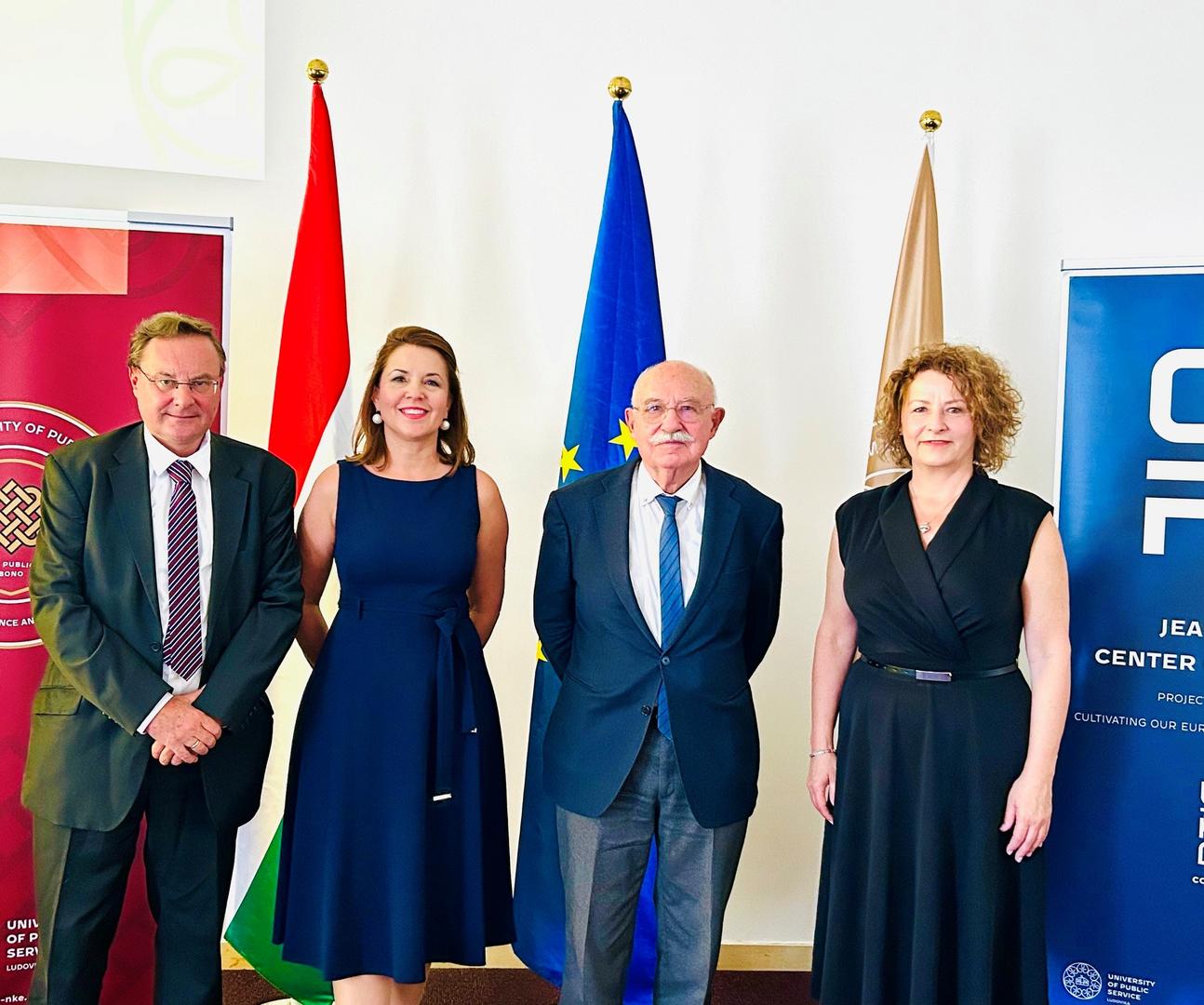
What does the history of European integration signal for our present? On June 12, the Ludovika University of Public Service hosted a high-level international academic event reflecting on the major milestones of European cooperation.
Organized by the Faculty of Public Governance and International Studies alongside the university’s CORE Jean Monnet Centre of Excellence, the event featured a keynote presentation and an expert roundtable. Under the title "Milestones of European Integration before and after Lisbon: Successes and Limitations of an 80-year Crisis Management Community (1946–2026)," the event focused squarely on the historical evolution, contemporary hurdles, and future trajectory of European integration.
Following a brief welcome, world-renowned historian Prof. Dr. Michael Gehler, Jean Monnet Professor at the University of Hildesheim, delivered a compelling keynote. He unpacked over eight decades of integration, highlighting the political, economic, and security dynamics that forged the continent's cooperation mechanisms.
Prof. Gehler explored the core drivers of integration – such as securing peace, boosting economic growth, and navigating the Cold War – while candidly addressing the structural limitations that have been present from the very beginning.
A major focal point of his presentation was the EU's evolving role in crisis management. Highlighting a fascinating paradox, Prof. Gehler noted that external (exogenous) crises have historically acted as catalysts, accelerating deeper cooperation. In contrast, internal (endogenous) crises tend to stall or actively hinder the integration process. Furthermore, he emphasized that today's complex, multifaceted shocks—ranging from the financial crash and migration pressures to the COVID-19 pandemic—represent a completely new paradigm that heavily tests the limits of EU decision-making.
The second half of the program shifted to a dynamic roundtable discussion titled "European Integration under Pressure: Historical Perspectives on Current Crises and Future Challenges". The panel brought together leading academic and diplomatic voices, including Prof. Dr. Michael Gehler, former Hungarian Minister of Foreign Affairs and legal scholar Prof. Dr. János Martonyi, along with Jean Monnet Professor and Director of the ELTE Institute of Political Science Prof. Dr. Krisztina Arató, and Prof. Dr. Boglárka Koller from Ludovika University of Public Service.
The experts placed today's challenges into a broader historical context, engaging in a high-level discourse on the EU's most pressing geopolitical issues. The conversation tackled the ripple effects of EU enlargement, the potential for differentiated integration, and the classic tug-of-war between centralized EU sovereignty and individual member state interests. The panel reached a clear consensus: the EU is currently navigating a profound transitional phase, delicately balancing the promise of deeper integration against the very real risk of fragmentation. They also spotlighted the EU's shifting global footprint, noting that evolving transatlantic relations are introducing complex new challenges for the bloc's common foreign and security policy.
The summit wrapped up with an engaging Q&A session, followed by an informal networking lunch that kept the policy debates flowing. Ultimately, the gathering offered participants a comprehensive 360-degree view of the EU's past, present, and future, fostering vital dialogue on key policy issues. Through this successful event, Ludovika University of Public Service reaffirmed its role as an active voice in international academic discourse, championing critical and forward-looking strategies for Europe's future.