Water and Gender: A Dialogue on Equality, Equity, and Our Shared Future
Water sustains life, shapes communities, and holds societies together—yet it is increasingly becoming a mirror of invisible inequalities, vulnerabilities, and conflicts. World Water Day 2026 reminds us that access to water is not merely a question of natural resource management or infrastructure; it is also a deeply social, cultural, and justice-related issue.
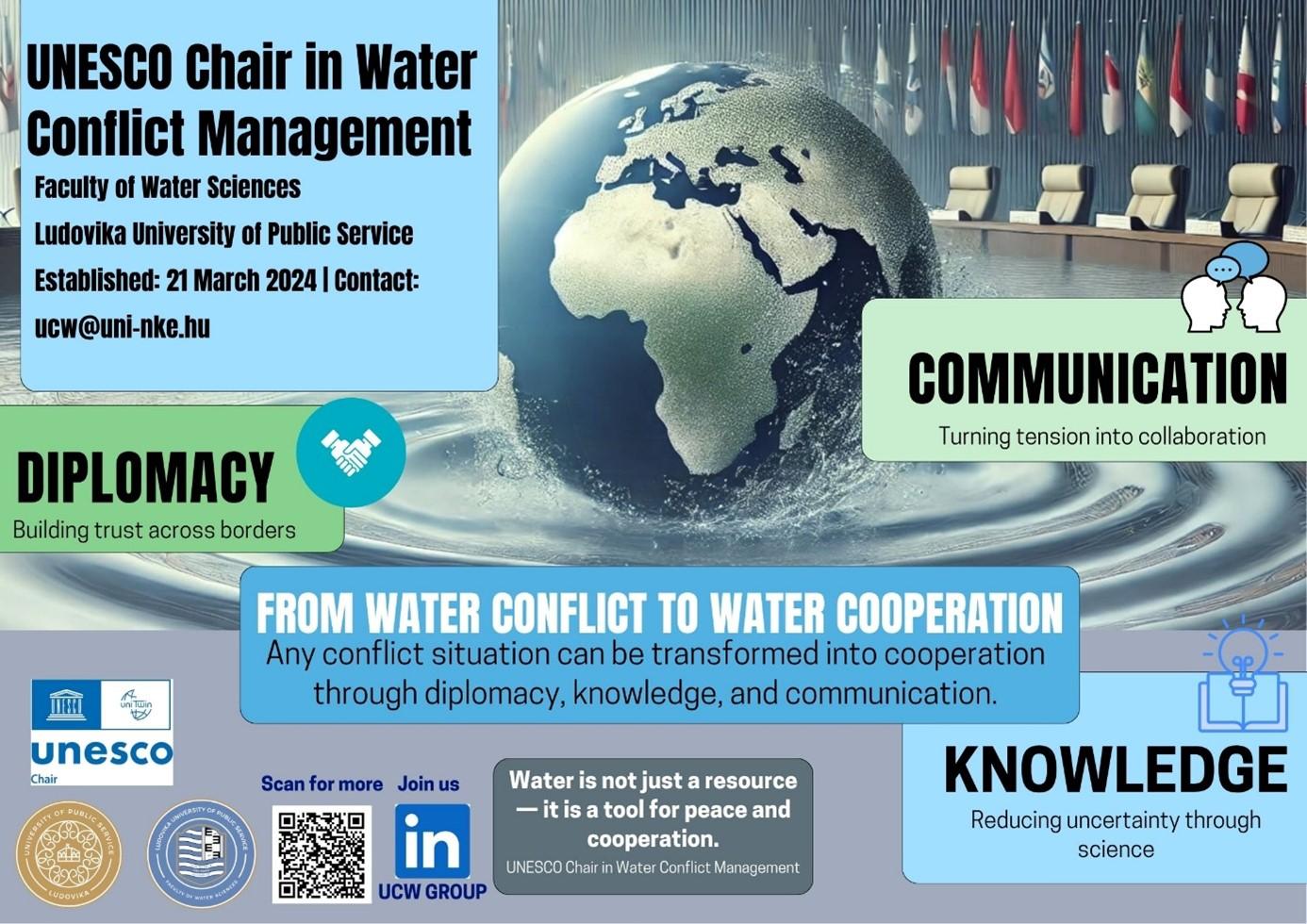
This edition of Water Dialogues 3.0 marks a particularly important milestone for us. Not only because, in connection with the global message of World Water Day 2026, this issue focuses on water and gender, but also because this year we celebrate the second anniversary of the UNESCO Chair in Water Conflict Management.
The Chair was established in March 2024, on World Water Day, at the Faculty of Water Sciences of the Ludovika University of Public Service, with the aim of strengthening the study of water-related conflicts, cooperation, and societal challenges within an international, interdisciplinary, and dialogue-based framework. Over the past two years, our founding team has not only grown in expertise, but also gained new momentum: we have expanded with young water professionals who bring fresh perspectives, international experience, and innovative approaches to communication.
We firmly believe that truly sustainable and equitable responses to the water challenges of the future can only emerge if we create space for intergenerational and multicultural dialogue. The experience, institutional knowledge, and historical memory of older generations are indispensable; at the same time, the sensitivity, digital fluency, and new social perspectives of younger generations are equally vital in understanding a rapidly changing world. This is the core mission of Water Dialogues: to build bridges between forms of knowledge, regions, professional communities, and generations.
The contributions in this issue reflect that mission. The theme of water and gender goes far beyond representation. It asks who bears the burdens of water insecurity, whose knowledge is recognized in decision-making, whose everyday experiences remain invisible behind policy frameworks, and how access to water shapes dignity, health, education, caregiving, and social participation. Through diverse regional and socio-cultural perspectives, the articles in this issue demonstrate that water security and gender equality are inseparable.
In this edition, we approach water not only as a resource, but as a matter of relationship, responsibility, and justice. We believe that contemporary water discourse can no longer focus solely on quantity, infrastructure, or technology—it must also speak about lived experiences, social inequalities, the invisible labor of care, and the voices that have too often remained at the margins.
For this reason, Water Dialogues 3.0 is both a celebration and a call to action: a celebration of two years of building the UNESCO Chair community together, and a call to make conversations about water more inclusive, more sensitive, and more just.
We would like to thank all those—authors, students, researchers, young professionals, and partners—who help ensure that this dialogue remains active, international, and future-shaping.