Water and Equality: A Cultural Anthropological Perspective
Water sustains life, yet access to it remains one of the most unequal realities of our world. Across continents, from drought-stricken regions to conflict-affected areas, the absence of safe water is not an isolated crisis—it is a shared, global challenge.
But water inequality is not only about scarcity. It reflects deeper structural divides. It shapes who learns, who works, and who carries the burden of survival. For millions of women and girls, the cost of water is measured in time, health, and opportunity.
In this issue, we explore water as more than a resource. We examine it as a question of equity, governance, and justice—one that connects communities across the globe and demands urgent, collective action.
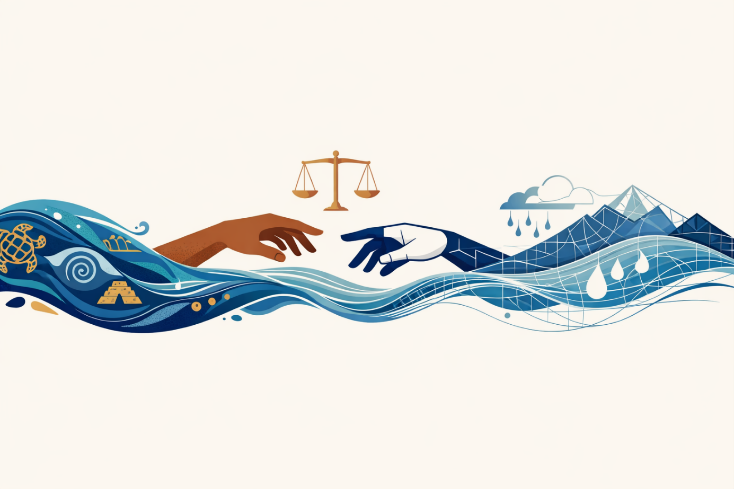
Water plays a vital role in our vibrant lives. It is a metaphor, an opportunity, a sacred entity, an essential source of life, and a geographical feature.
In this article, I will explore the anthropological and philosophical background of water connected with equality.
Water has shaped the history of humankind, Great civilizations were built on water, and failed, due to inadequate management, or a distinct institutional background. Cradles of civilization, like the Yangtze, Nile, Tigris and Euphrates shaped the fate of historical societies (Orlove & Caton, 2010). The most well-known monotheistic religions: Judaism, Islam, and Christianity have their own doctrines about how to use and share water with other segments of society. Even the Talmud prohibits exploitative behaviour towards nature and the environment. In Christianity, water also plays a central role during baptism. Environmental stewardship enhances the protection and management of natural resources both in Christian and Islamic cultures (Linda Reijerkerk & Lida Schelwald-van der Kley, 2012).
Another central idea that shaped the relations between human and nature emerged in ancient times and called anthropocentrism. Anthropocentrism is the current philosophical justification for handling nature and the environment in favour of humankind. Even religious sources, like Genesis, says that God instructed humans to subdue the Earth and to have dominion over all living creatures (Environmental Ethics | Definition, Examples, Future Generations, & Facts | Britannica, n.d.).
Some cultures, for example, the Māori people in New Zealand, see water not as a tool for human well-being, but as a sacred individual entity that is in harmony and equality with the indigenous population. The Māori people succeeded in defending their sacred river by giving it a legal personhood (Te Awa Tupua (Whanganui River Claims Settlement) Act 2017, n.d.). The Māori concept of “whakapapa” (genealogy), which links humans, lands and water, created the legal background for the Act. As the Māori proverb says, “Ko au te Awa, ko te Awa ko au“ (I am the river, the river is me) (Salmond, 2014).
Not just religion and philosophy, but science has also shaped the definition of water throughout history. In the 20th century Karl Wittfogel, a German-American historian developed a general reasoning about the relationship between water and society with his crosscutting book Hydraulic Society. Wittfogel argues that in early human history the volatile river conditions and water scarcity forced communities to invent centralized bureaucracies, mathematics and complex legal codes. Centralized management of water led to the birth of modern states (Spate, 1959).
By the close of the 20th century the hydrological cycle, or water cycle, emerged as a key concept in our understanding of life and the environment. It’s a closed and continuous process, that describes the movement and renewal of water below and above the surface (Hydrologic Cycle - an Overview | ScienceDirect Topics, n.d.). This concept aimed to explain our reality and therefore improve the human environment. The key limitation of the scientific concept was, that it did not consider socio-cultural norms and ways of life. Some locally effective solutions may not work effectively globally. For example, when Yemen tried to modernise its water system, management and infrastructure, the local communities resisted the reforms. The idea was altruistic, as every citizen was supposed to be equally entitled to water. However, this idea, when implemented in practice, led to the impoverishment of local elites, especially the sheikhs. The shift to modern technology disrupted traditional power, historically tribal leaders and sheikhs managed water through customary Islamic law (shari’a) and local tribal rules (‘urf), which enforced a degree of equality and sustainability. The introduction of unregulated deep well drilling led to the impoverishment of the main societal strata (Orlove & Caton, 2010).
To manage future water issues, the International Hydrological Programme (IHP) was established within the UNESCO framework. It functions as a bridge between science and anthropology facilitating the creation of an equitable and sustainable environment. The Network of Water Anthropology (NETWA) was created under the International Hydrological Programme (Global Network of Water Anthropology for Local Action - UNESCO Digital Library, n.d.). Innovations like NETWA support sustainable development, social equity and equality. During project implementation they also pay attention to local customs and traditions related to water. Local traditional solutions and modern approaches are often implemented simultaneously. Science and anthropology are complementary to each other in the field of water management.
Text: Péter Toronyi