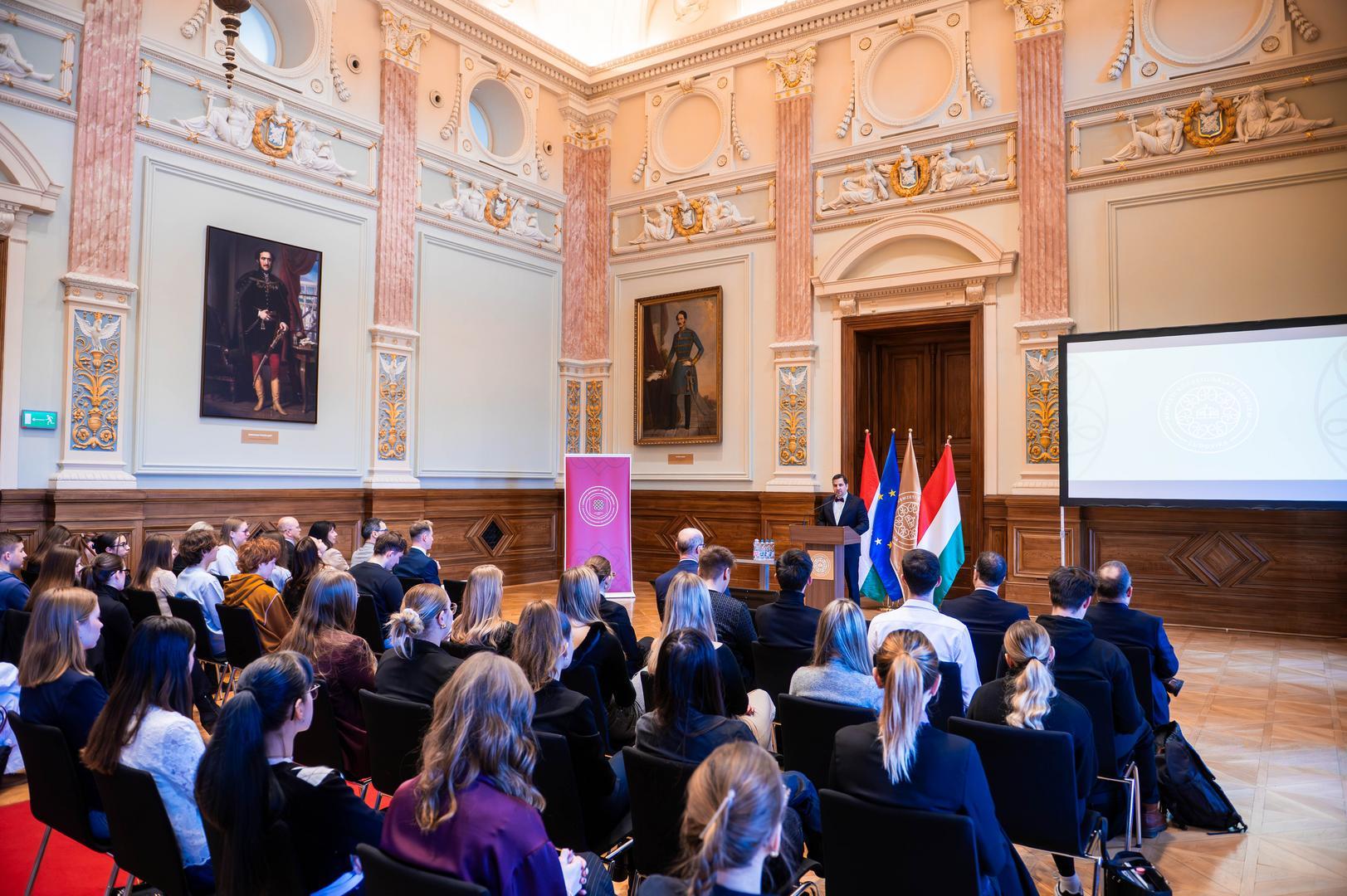
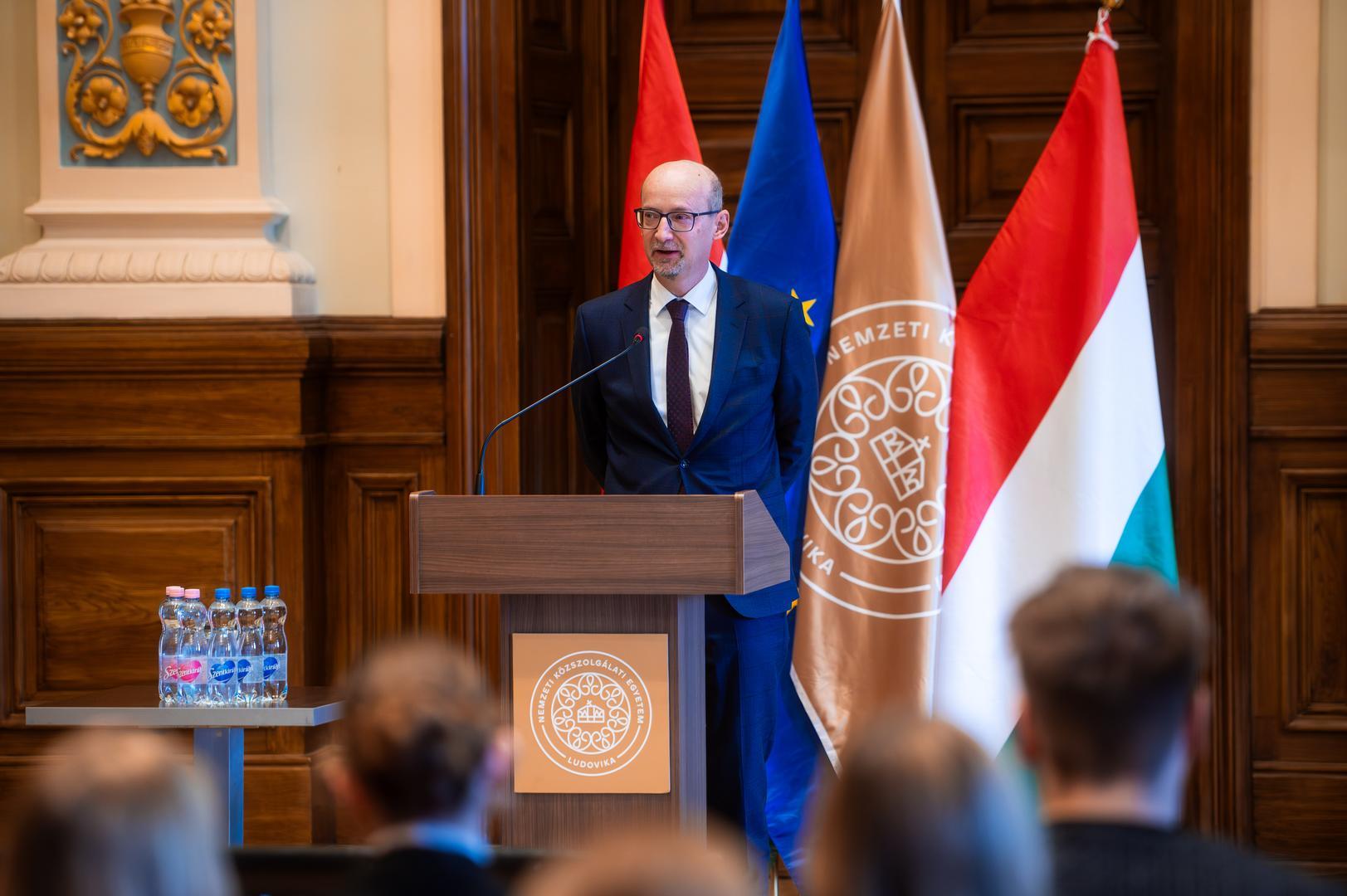
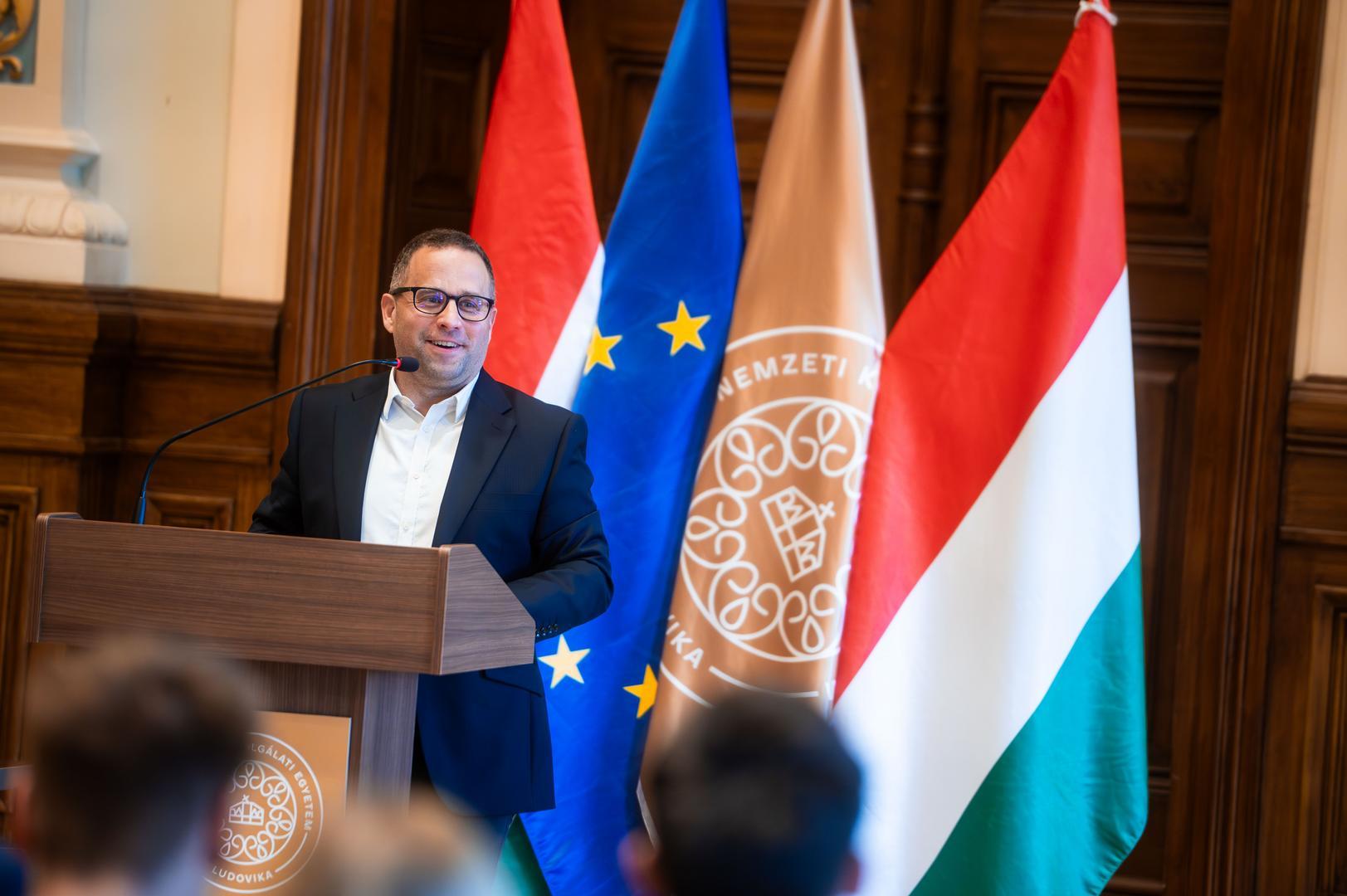
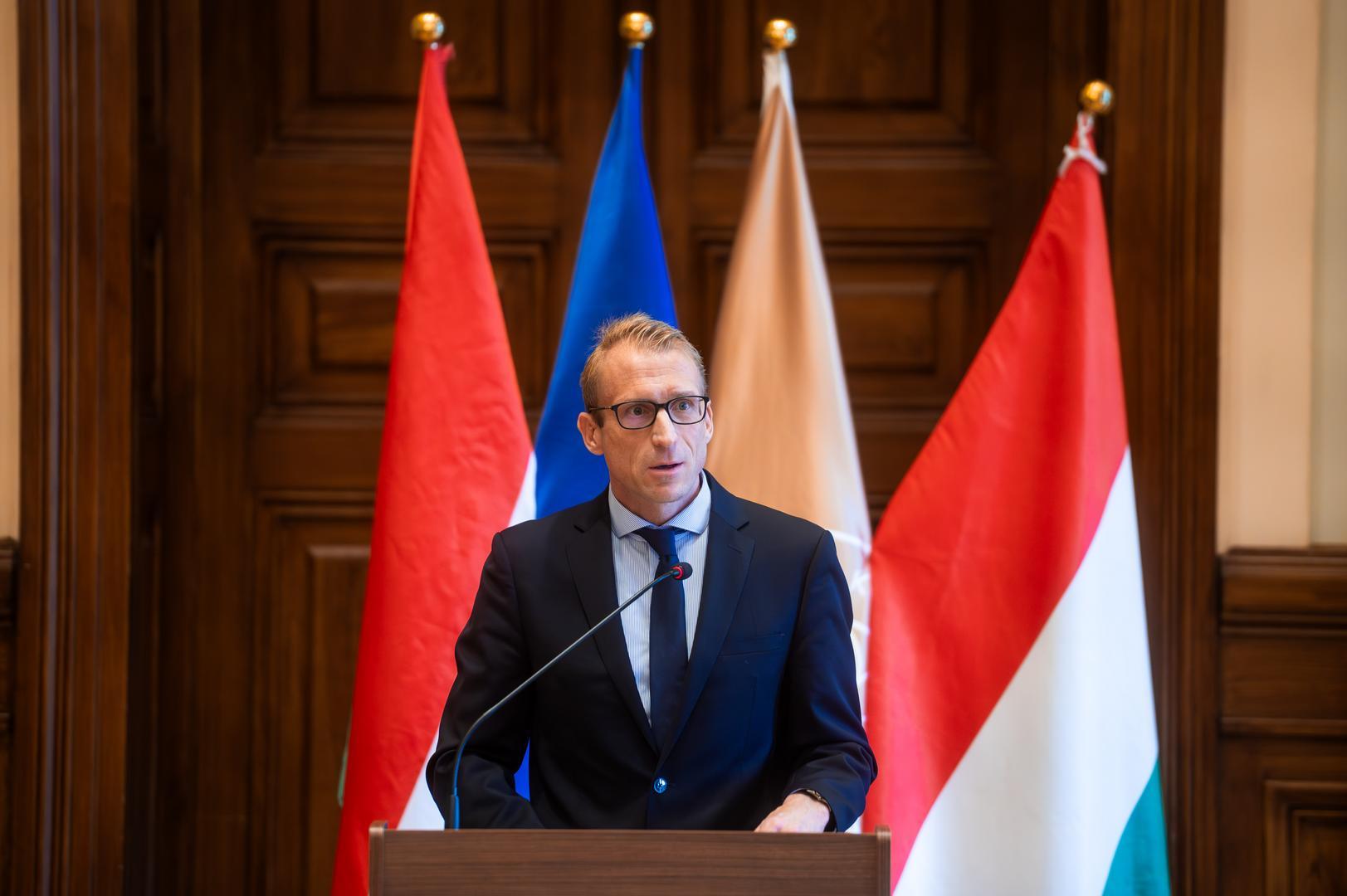

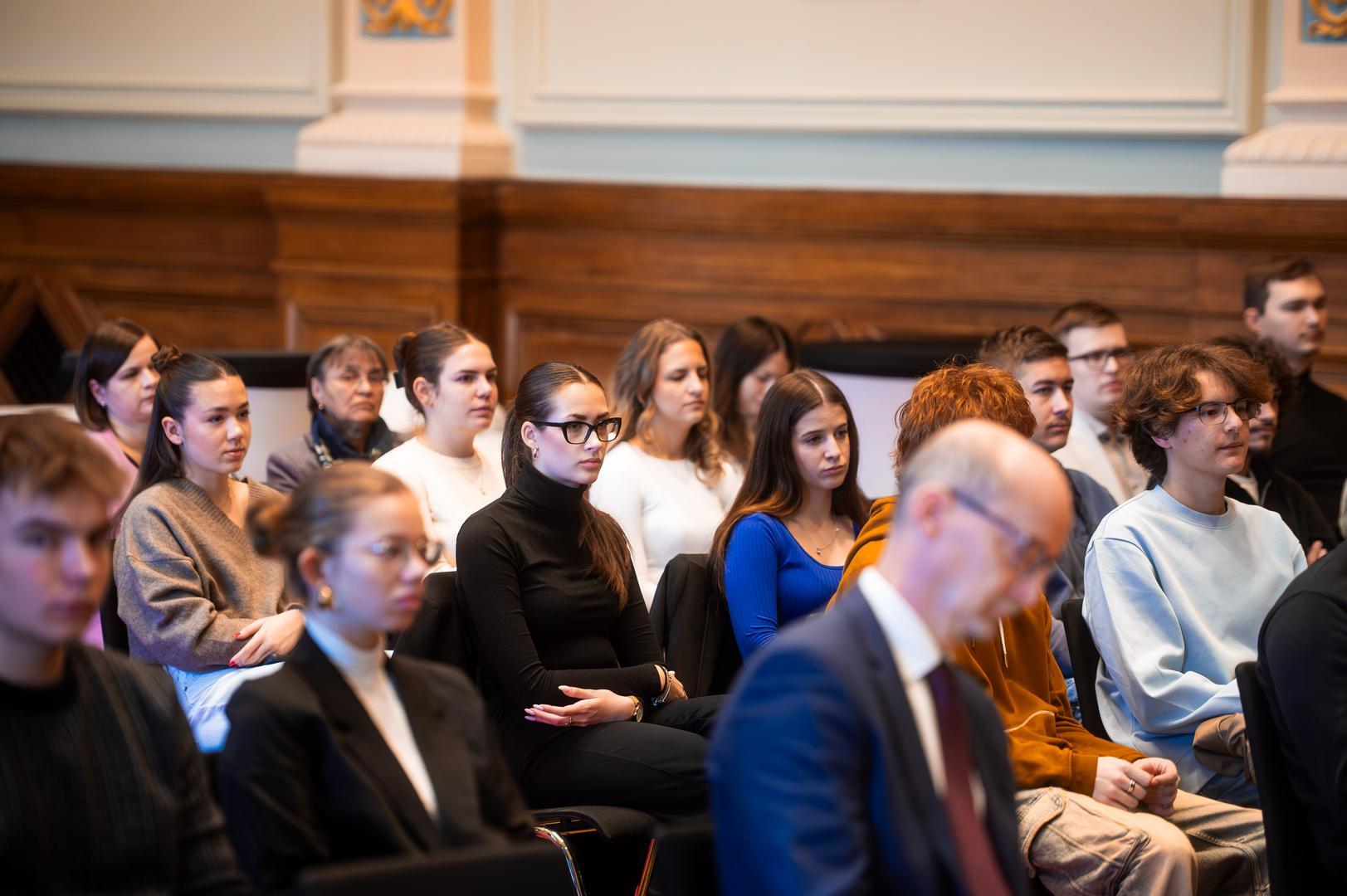
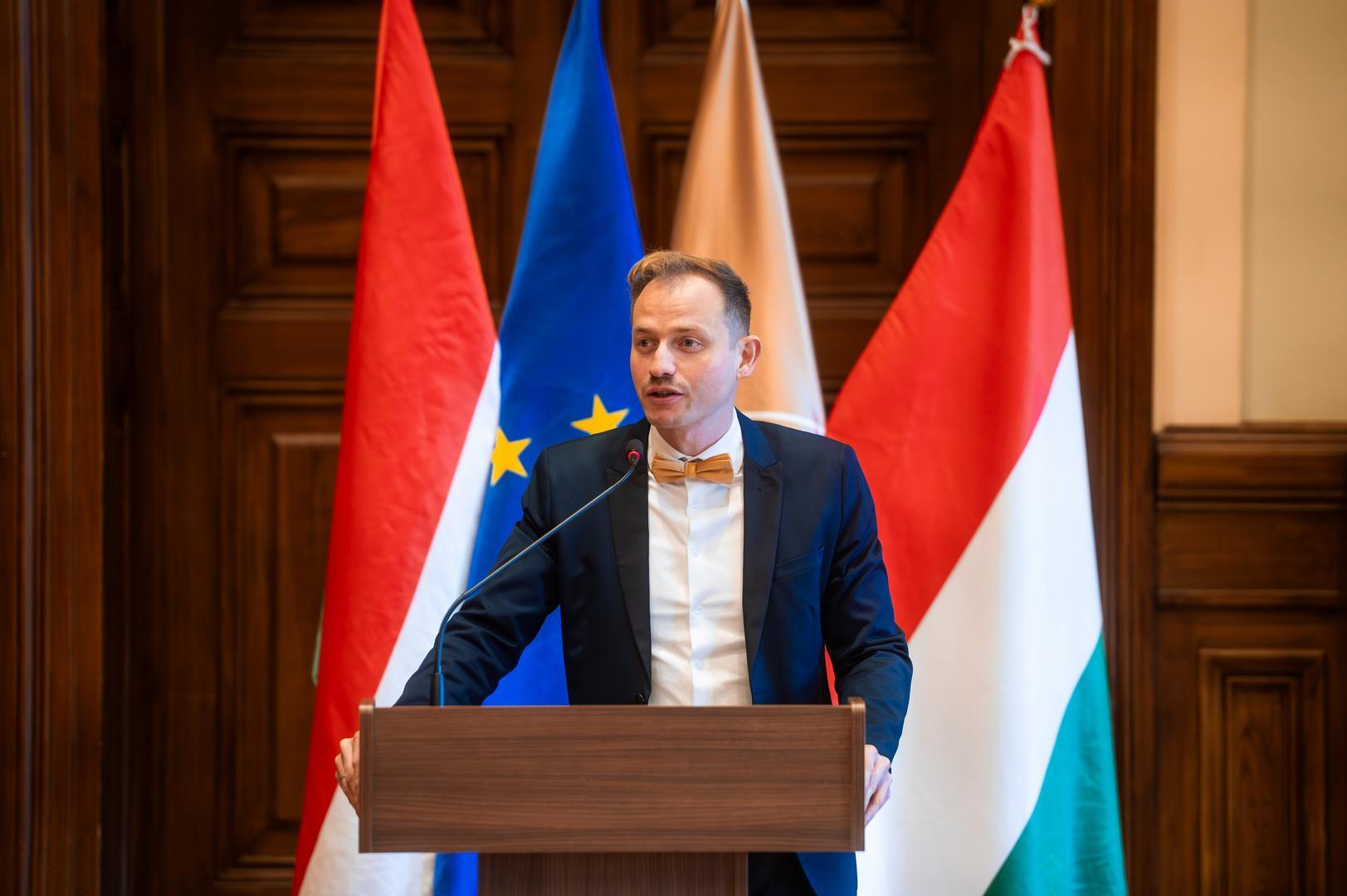
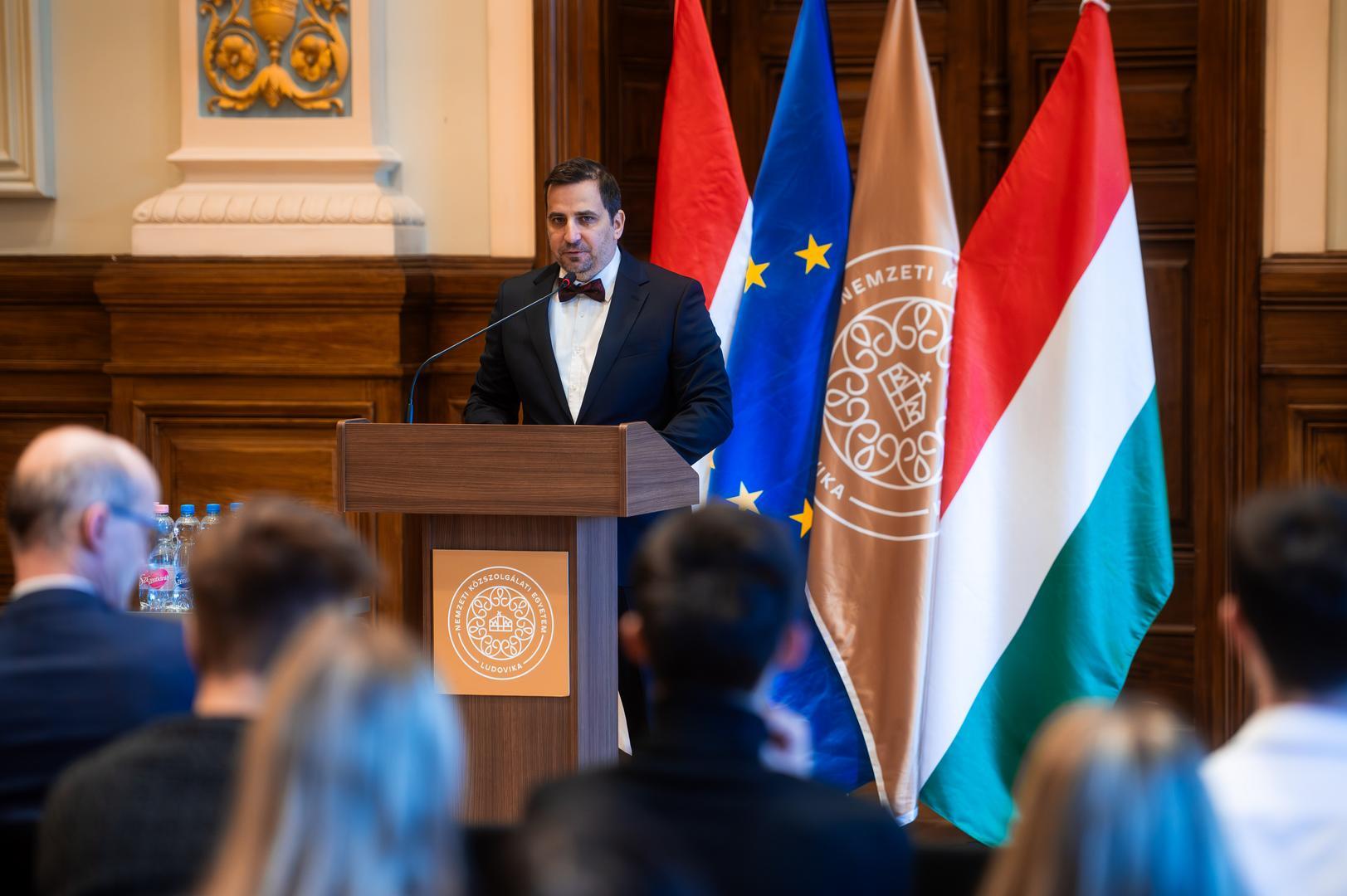
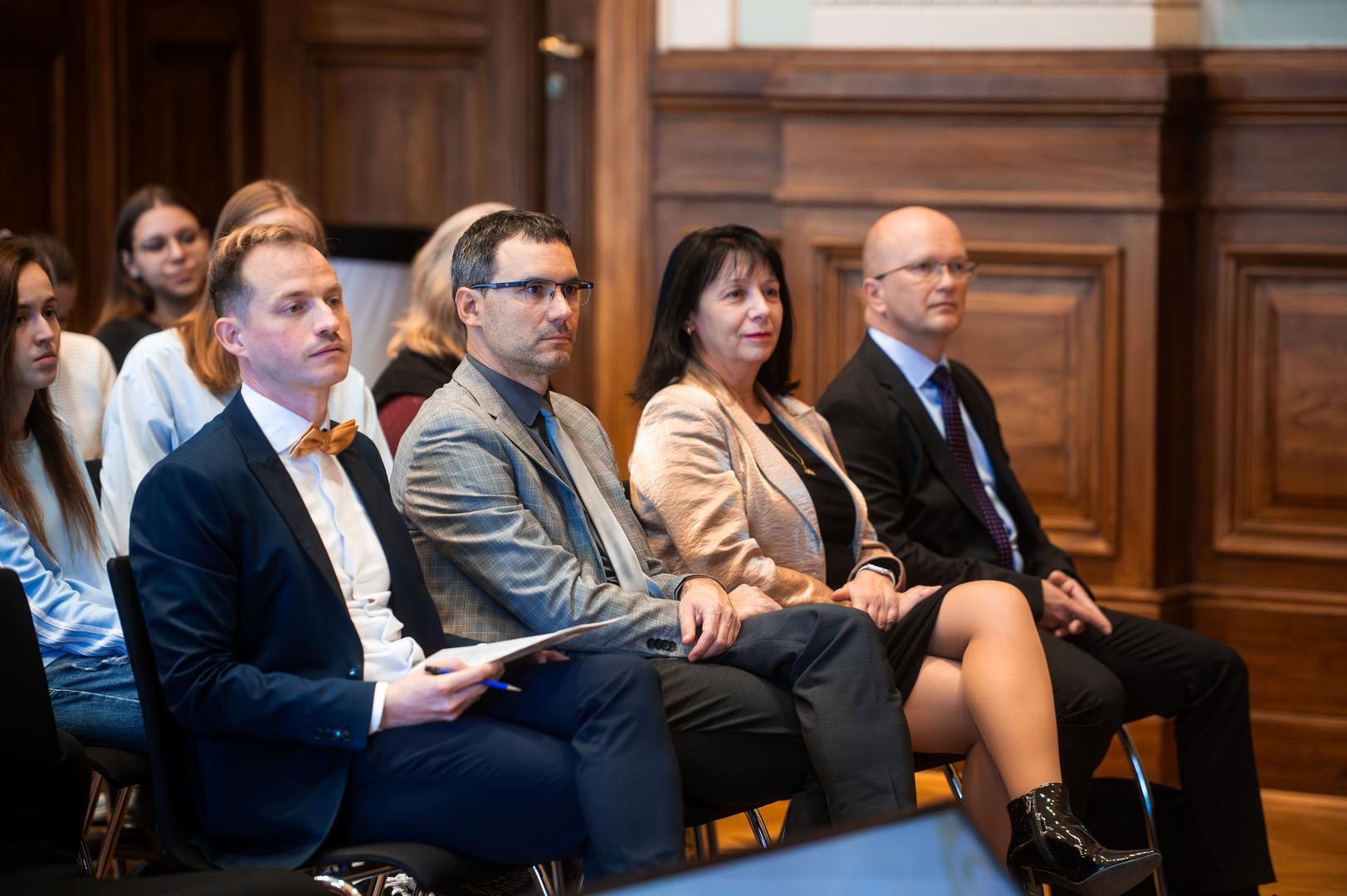
The Faculty of Public Governance and International Studies at the Ludovika University of Public Service (NKE-ÁNTK) held a one-day conference on the past, present, and future of the Court of Justice of the European Union (CJEU) in the Széchenyi Ceremonial Hall on November 27.
In his opening speech, Gergely Deli, Rector of the University, emphasized the importance of legal unity and coherence in European integration, and stressed the key role of judicial interpretation in maintaining a common legal order. He highlighted that the conference was significant in bringing together judicial and academic perspectives, and underlined one of the main goals of the university, which is “to train professionals who can navigate the complex legal environment of the EU.”
The first speaker, Tihamér Tóth, Judge at the General Court of the Court of Justice of the European Union and Professor at the Faculty of Law and Political Sciences at Pázmány Péter Catholic University, gave a detailed presentation on the EU’s system of restrictive measures and their judicial review. As he explained, the legally correct term is “restrictive measures” rather than “sanctions”, the term commonly used in the press. These measures relate to foreign and security policy, and they may affect civilians and businesses (e.g.: asset freezing, travel bans). However, they are neither punitive in nature nor intended as retaliation. He underlined that restrictive measures are generally valid for six months and must be renewed regularly.
Research Professor Márton Varju (ELTE Centre for Social Sciences, Institute for Legal Studies) examined what motivates Member States to bring direct actions before the Court of Justice of the European Union, especially, when they challenge EU legislation (directives, regulations). In this regard, he noted that these lawsuits often prolong political conflicts that were also present in the decision-making process.
Krisztián Kecsmár, Judge at the General Court of the Court of Justice of the EU, gave an overview of the recent competition law practice of the General Court, with particular regard to cases related to digital markets. As he explained, digitalization poses new challenges for competition authority controls. Among other things, he pointed out that sport could not be placed under a separate regulatory system: the decisions of large sports associations are also subject to competition law controls (Super League).
In the second panel, Miklós Zoltán Fehér, Head of Department for the CJEU at the Ministry of European Union Affairs, gave an overview of Hungary’s participation in proceedings before the CJEU since its accession to the EU. He recalled that since 2004, the number of cases before the court has increased dramatically: the number of new cases has risen from more than 500 to nearly 900, and the number of preliminary ruling proceedings has doubled. This increase is linked to the expansion of EU legislation, the more active participation of national courts, and the professional level of litigation. He explained that Hungary participates in the proceedings in several capacities: as a defendant in infringement proceedings which often concern sensitive issues (national legal acts, implementation of directives, etc.); as a plaintiff in actions for annulment of EU legal acts, if the government considers that the EU legal act in question exceeds the EU’s competences or is procedurally or substantively flawed. Finally, in preliminary ruling proceedings, the Hungarian government makes statements and participates in the hearing in all Hungarian preliminary ruling cases. In the latter procedure, he mentioned tax matters, in particular VAT, and consumer protection matters as priority fields of litigation.
Balázs Lehóczki, advisor to the Communication Directorate at the Court of Justice of the European Union, gave a presentation on how the CJEU’s communication has changed over the past decades and in what direction it is developing. Three key values were emphasized: comprehensibility, transparency, and technological innovation. He recalled that the court’s communication was extremely limited previously, confined almost exclusively to the publication of judgments and a few press releases. However, with growing political and social expectations, the court is developing in three main directions: press releases are now shorter, clearer, and written in a less technical language. The future lies in the development of new platforms and digital leaps (Web TV) to make the functioning of the EU judiciary accessible in a way that is easy to understand and visually appealing.
The next speaker, József Villányi, Head of the Croatian Translation Department at the European Parliament, reviewed how the role and legal status of the European Parliament (EP) have developed and what decisive role the Court of Justice of the European Union has played in this process. He recalled that the relationship between the EP and the CJEU has become a key element of the EU’s constitutional structure. The way forward is cooperation and constitutional development: an annual dialogue between the CJEU and the EP was launched in 2024 and held for the second time in 2025. Looking ahead, he mentioned possible proposals for Treaty amendments that include the extension of the EP’s right to legislative initiative, reforming the Council’s voting rules, and strengthening constitutional control. In addition, József Villányi also noted that enlargement brings new constitutional pressures: the roles of the institutions need to be clarified, and the capacity of the court needs to increase.
In the afternoon, Zoltán Csehi, Judge at the Court of Justice of the European Union, outlined the legal and institutional background of the CJEU’s judgment in the Kubera case (2023). Drawing on his own judicial experience, the speaker placed the issue in a broader context, discussing how the procedural autonomy of Member States conflicts with the requirement for the effective enforcement of EU law. As it is well known, the case originated in the Slovenian Kubera customs case, more specifically in the application of EU customs and intellectual property rights rules, which raised questions about the specific procedural practice of the Supreme Court of Slovenia. One of Zoltán Csehi’s main conclusions was that the CJEU was becoming increasingly strict in checking whether national courts are properly ensuring the enforcement of EU law. In addition, he stressed the particular importance of the right to a fair trial, namely the increasing role of Article 47 of the Charter of Fundamental Rights.
In her presentation, Réka Somssich, Professor at Eötvös Loránd University Faculty of Law, discussed the relationship between the so-called CILFIT criteria, the obligation to initiate a preliminary ruling procedure, and the role of infringement proceedings in the case law of the Court of Justice of the European Union. The speaker explained that although the CILFIT criteria exist in theory, they have never been applied in practice in their entirety. She added that the CJEU refined the CILFIT test in its Consorzio judgment, but did not abolish it. She mentioned that the emphasis had shifted to the obligation to state reasons, while there is constant tension between the unity of EU law at the macro level and the protection of individual rights at the micro level, and the diverse approach among Member States is also becoming an increasing challenge.
Finally, Katalin Gombos, Professor and Head of the Department of European Public and Private Law at NKE-ÁNTK, presented the development of the Court of Justice of the European Union and the transformation of the preliminary ruling procedure in her lecture. She emphasized that the relationship between the Court and the courts of the Member States is constantly evolving, and that the CJEU and the preliminary ruling procedure are currently undergoing transformations. The 2024-reform created a new division of powers, which might speed up case handling, and also provided considerable new guarantees to protect the unity of EU law. As Katalin Gombos concluded, the preliminary ruling procedure remains the most important tool for direct dialogue between the national courts and the CJEU.
After the presentations, Endre Orbán’s new book titled A Case Law-Based Approach to EU Law – The Court of Justice of the European Union and Its 120 Significant Decisions was presented during a panel discussion. In addition to the author, József Villányi, linguistic lector of the book, Professor Katalin Gombos, lector of the book, and Assistant Professors Kornélia Kozák, Anikó Edit Szűcs, and László Selnicean participated in the discussion. The author explained that the book aimed to present the most important judgments of the Court of Justice of the European Union in a structured manner, based on clear dogmatic principles. The structure of the work includes an introductory chapter dealing with the evolution of the institution, its procedures, and the development of case law of the CJEU. This is followed by the discussion of 120 cases, each with a summary of the facts, an assessment, and, where relevant, a verbatim quotation from the court so that the court’s reasoning can be understood. The concluding chapter deals with the role of the CJEU and provides an overview of the contemporary tendencies and discussions present in the international literature.
The speakers emphasized that although the book appears to cover a wide range of topics, it appears as a coherent whole as one reads it. It is useful for anyone who wants to understand how EU law affects our everyday life, and what methodological approach is needed to understand the case law of the CJEU. When writing the book, translation also played a key issue: the author included several judgments which did not have an official Hungarian version; these were translated and proofread with József Villányi’s help. In brief, participants agreed that the volume would greatly assist students in developing their case interpretation skills.