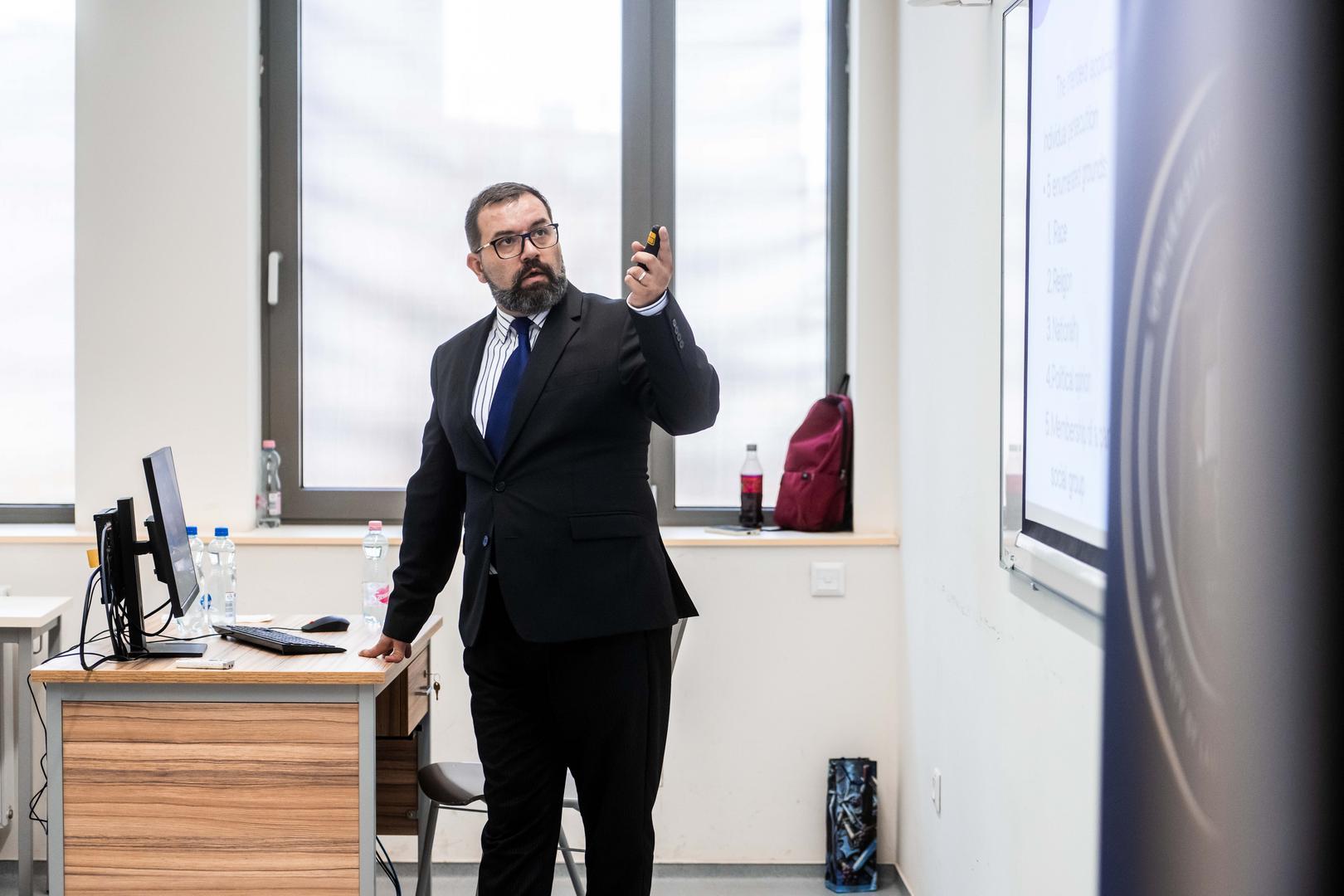


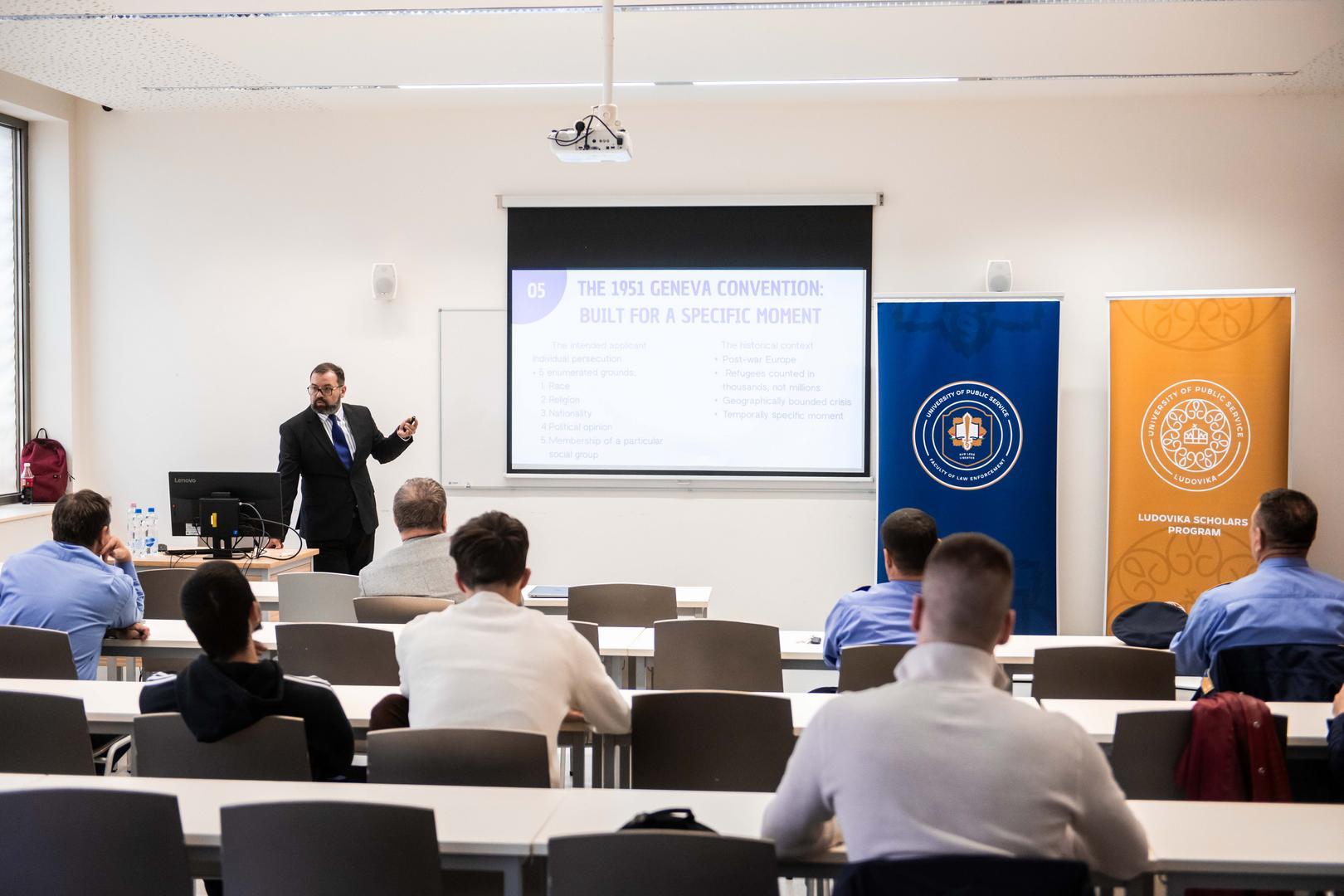



On April 21, the Ludovika University of Public Service held a public lecture as part of its Ludovika Scholars Program at the University’s Educational Centre. The guest speaker was Adrian Băncilă, an Associate Professor at the Alexandru Ioan Cuza Police Academy and the Director of the undergraduate program in Law Enforcement and Public Safety. During his presentation, he discussed the increasing challenges confronting the international asylum system and explored the future of refugee protection policies.
The lecture began with a comparative analysis of current asylum policies and their evolving strategies across Europe and beyond. By questioning whether the international refugee protection system inherited from the 20th century still fulfils its original purpose, Adrian Băncilă urged the audience to critically assess restrictive asylum strategies, their limitations, and potential avenues for future reform.
To demonstrate the magnitude of the issue, he noted that over 120 million people are currently displaced globally, while the European Union receives approximately one million asylum applications each year. He emphasized that the 1951 Geneva Convention was established for a vastly different time, when refugee movements were counted in thousands rather than millions, and the system primarily focused on individual persecution cases. In contrast, today’s migration is increasingly influenced by a mix of climate-related disasters, failed states, economic hardship, and other intricate crises.
According to the speaker, the European Union, the United Kingdom, and the United States are all heading in a similar direction: upholding the formal right to seek asylum while imposing practical limitations through procedural obstacles. He elaborated that the EU’s new Migration Pact, for instance, officially guarantees the right to apply for asylum; however, expedited procedures, border checks, and limited legal access significantly restrict this right in practice. As he pointed out, the form safeguards the right, while the substance constrains it.
He also mentioned the United Kingdom’s Rwanda policy (UK and Rwanda Migration and Economic Development Partnership) as an illustration of deterrence-based migration management. According to this rationale, asylum seekers are redirected to other locations instead of being permitted to stay in the UK, irrespective of whether they are escaping war, poverty, torture, or violence. Nevertheless, Adrian Băncilă contended that such restrictive systems encounter significant practical challenges: while numerous applications are denied, only a small percentage of those individuals can actually be deported, highlighting the system’s failure to implement its own rulings.
Similar trends can be seen in the United States, where the volume of asylum applications continues to grow despite heightened restrictions, and where certain measures have progressed beyond procedural constraints to substantive limitations on protection itself. The Danish and Italian–Albanian models further illustrate that outsourced or largely symbolic solutions frequently do not yield effective outcomes.
In conclusion, Adrian Băncilă posed a critical question: if a system exists solely in name but fails to function in practice, should it be maintained, reformed, or even entirely replaced? In his opinion, this issue transcends mere legal considerations, evolving into a political, moral, and trust-related challenge for contemporary societies.
Text: Éva Harangozó
Photo: Dénes Szilágyi