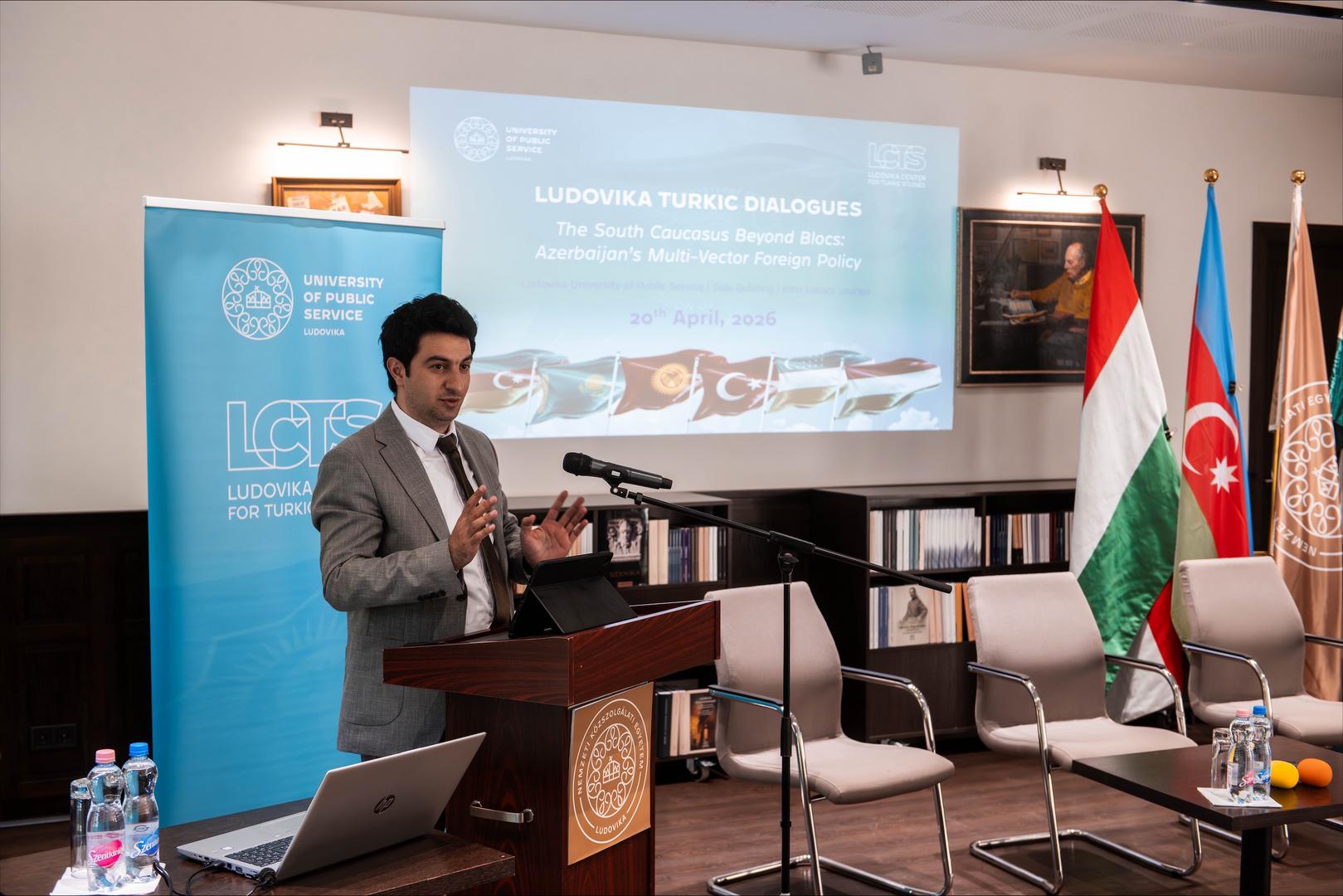
The latest event of the Ludovika Turkic Dialogues series, named “The South Caucasus Beyond Blocs: Azerbaijan’s Multi-Vector Foreign Policy,” was held on April 20 at the John Lukacs Lounge of the Ludovika University of Public Service. The key areas of the discussion included Azerbaijani foreign policy flexibility, shifts in the balance of powers in the region, and development of Hungarian–Azerbaijani relations.
Opening remarks were made by Liliana Śmiech, Director General for International Affairs of Ludovika University of Public Service. According to her opinion, because of its geographical location and history, Azerbaijan still functions as an area of interaction between different regions, cultures, and economic interests. One of the purposes of its multi-vector foreign policy is the preservation of its freedom of action amidst changing global politics. Regarding partnerships, the cooperation between Hungary and Azerbaijan increased during recent years through institutional ties and dialogues.
Vasif Huseynov, who heads the Western Studies Department of the Center for Analysisof International Relations in Baku, highlighted that Azerbaijan, which is located within the Turkic civilization, Islamic world, and former Soviet Union, at the same time operates as a secular state. This peculiarity largely determines its international policy.
He pointed out that Azerbaijan had been founded in 1918 as the first state in the Islamic world and was one of the first nations to give women the right to vote. Throughout decades, the policy of Azerbaijan had revolved around the idea of the restoration of territorial integrity, while the war of 2020 can be regarded as the beginning of a new era. Despite the fact that the text of the peace treaty has already been discussed by Armenia and Azerbaijan, not all the preconditions necessary for signing the document are ready yet.
Azerbaijan is located between Russia and Iran and faces the armed conflict from two directions at once; however, it succeeds in maintaining its neutrality. Oil and gas exports still play a vital role, although they are replaced by alternative means, like renewable energy, which has and will have a significant role in the future.
In the next panel session, Vasif Huseynov, László Vasa (Director of the Ludovika Research Center for Turkic Studies), and Sándor Seremet (Senior Researcher at the Hungarian Institute of International Affairs) had an insightful discussion. An important issue in the discourse was the development of Azerbaijan’s foreign policy after its independence. As Huseynov noted, Azerbaijan tried different models after the collapse of the Soviet Union. Initially, the country followed the Russian model but gradually shifted towards the Western and Turkish ones. Finally, Heydar Aliyev established a balanced policy that aims to establish good relationships with Russia, the West, Turkey, and most recently with China.
Sándor Seremet shared his point of views concerning the changing nature of geopolitical dynamics in the South Caucasus region. Whereas the region had been operating under balance all along, recent conflicts have brought about a major shift in the dynamics of power. The influence of Azerbaijan has grown stronger, that of Russia has diminished, and Iran has limited space for manoeuvrability, while Turkey being the most powerful external power player. However, Russia cannot be discounted as it has a huge stake in the South Caucasus.
László Vasa highlighted the evolution of Hungarian-Azerbaijan relations. Cooperation in the energy field is very important, yet the bilateral relationship goes beyond that policy area. Besides the natural gas supply, the role of green energy connectivity becomes more noticeable with the Black Sea cable project potentially carried out in collaboration with Azerbaijan, Georgia, Romania, and Hungary. Hungarian enterprises operate more frequently on the Azerbaijani market; moreover, air connections, tourism, sister cities, and the Stipendium Hungaricum program are among other significant factors.
With regard to Azerbaijan's relation with the European Union, the complex nature of the nation has also been highlighted due to this state being an energy supplier, transit state, and bridge between Europe and Asia at the same time.