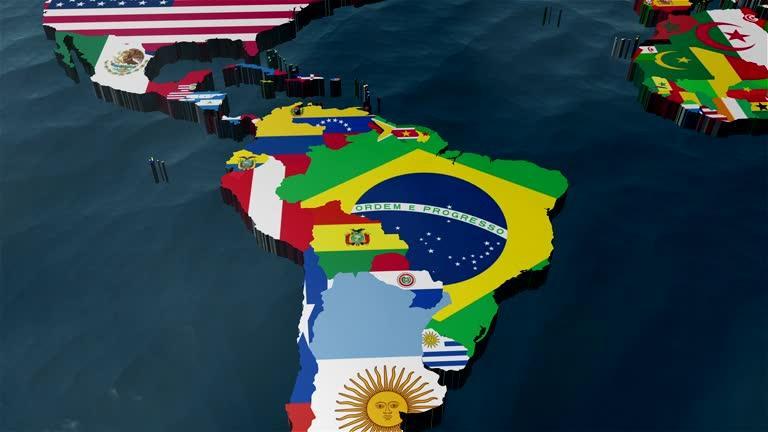
It is a scientific and diplomatic success that in 2027 the capital of Hungary will host the 21st Congress of the Association of European Historians of Latin America (AHILA). We spoke with Prof. Dr Mónika Szente-Varga, university professor, Vice Dean for Education of the Faculty of Military Science and Officer Training (FMSOT) at Ludovika University of Public Service (LUPS), and Chair of the event’s Organizing Committee, about the significance of the event and the background of its organization.
“AHILA was founded in the late 1970s with the primary aim of building a bridge between researchers working on the two sides of the Iron Curtain and of supporting European research on Latin America,” the Vice Dean for Education began her overview. As she explained, the organization has since become one of the world’s most significant Latin Americanist scholarly communities, and since 2002 it has no longer distinguished between European and non-European members. “We are particularly proud that although the congress has been held in numerous world cities since 1981, Budapest will be the first Central and Eastern European capital to host the meeting,” emphasized Mónika Szente-Varga, AHILA’s regional coordinator.
The right to host the congress was jointly won by LUPS FMSOT and the Department of Hispanic Studies of the University of Szeged (USZ) at the 2024 world conference held in Italy. “The venue of the 2027 congress will be the Ludovika Campus of LUPS, which will provide a worthy setting for global scholarly dialogue,” the Vice Dean added. She also noted that in Hungary AHILA has held a congress only once before, in 1987 in Szeged, thus the Budapest event will also commemorate the 40th anniversary of the Szeged meeting and the 50th anniversary of the organization itself.
“The central theme of the congress will be Latin America in History: Resources and Challenges,” Mónika Szente-Varga pointed out. The program will cover all key areas, from historical roots to the most pressing problems of the modern era, whether drug trafficking, energy security, or environmental challenges. “In addition to social, political, security, economic, and cultural changes, the congress will also provide an opportunity to examine Latin America’s relations with other regions,” detailed the Vice Dean for Education, who, as a historian and Latin America scholar, has been a member of the Association of European Historians of Latin America for more than twenty years and a regular participant in AHILA’s triennial congresses.
The 2027 Budapest congress may contribute to increasing the visibility of Latin America in Hungary, encourage the development of the next generation of scholars, and strengthen relations between Latin America and Central and Eastern Europe. It may serve as a bridge between European and American researchers, as well as between Ludovika University of Public Service and other institutions of higher education.
Continuously updated information related to the congress is available HERE.
Text: Agnieszka Németh-Zsohár