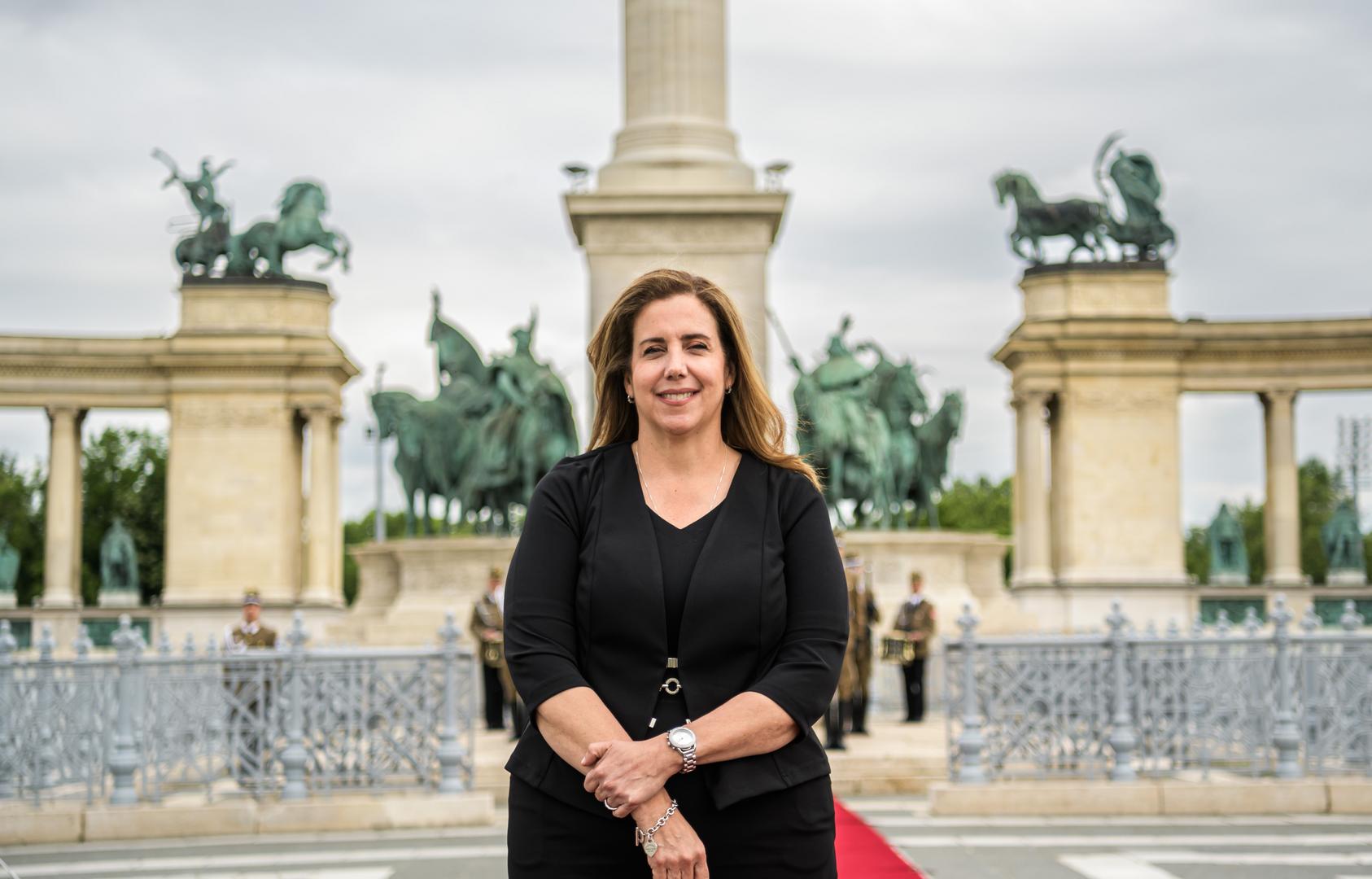
Interview with the next guest of the Ludovika Ambassadors’ Forum: Ecuador’s Ambassador, in Budapest, Cynthia Mayer Zavala on Bilateral Ties, the 80th Anniversary Program, and Women’s Leadership in Latin America.
The next session of the Ludovika Ambassadors’ Forum will take place on 5 February.
Coming from a business environment, from Latin America, when did you get your first impressions of Hungary?
My first impressions focused mainly on the opportunities available to develop new trade and investment between both countries. When I arrived, I saw many Ecuadorian products in supermarkets. But when you look at the statistics, reports, and numbers, they didn’t really appear. That was my first question: what’s happening, why? It looked like there wasn’t much trade, but when you go to the shelves—in supermarkets, retail—you really see it. And in flower shops too: Ecuadorian roses, Ecuadorian bananas everywhere. So I began to research, and I saw there is definitely an opportunity because many of those products come through another European importer. For example, they come through Hamburg, the German port. Then the data suggests Germany imported them, but actually they are not for Germany—they come directly here to Hungary. That’s how I started checking the real numbers and what is really happening, and that’s how I saw many business opportunities—especially the opportunity to connect Hungarian partners directly with Ecuadorian counterparts, so the products can be more competitive and maybe the portfolio broader. That’s why, on the business side, I see many opportunities to grow in the coming years.
As Ambassador to Hungary since 2024, how do you assess the past period in terms of Ecuadorian-Hungarian bilateral cooperation? What are the main bilateral achievements?
As I said, there are many opportunities, and there are challenges too. On the opportunity side, cooperation in education is getting stronger and stronger. We have a very good number of Ecuadorian students who come here through the Stipendium Hungaricum program, and they represent the best of my country here. Some of them later stay here, maybe for a job or for family, so they create long-term connections. Culturally and on the tourism side there is also huge potential. I didn’t know that Hungarian tourists were looking forward to learn more about the Galapagos Islands, the Chimborazo volcano and the Andean mountains —things like that impressed me a lot. I think if we can show more information and connect Hungarians and Ecuadorians better on these three levels, we can develop many things.
Ecuador and Hungary celebrate the 80th anniversary of the diplomatic relations this year. How do you plan to celebrate this? Will there be any special events or visits on this occasion?
Yes, indeed. Diplomatic relations between Ecuador and Hungary were established in 1946, and this is something we have to celebrate this year with this anniversary. At the embassy we prepared a full annual program—various events throughout the year within this framework.
We’re going to have a documentary about the Galápagos at the Ervin Szabó Library in April. We’re going to have a concert by an Ecuadorian philharmonic orchestra in July. We will also have an exhibition of Ecuadorian painters in May. We will have trade missions coming for business. We will organize tourism-related events with travel agents and also for Hungarian tourists to learn more about Ecuador. It’s a full list of 12 events. And the good thing is that the Ambassadors’ Forum will also be part of this special year, and I’m happy to be part of it next week.
Also, this year on the 9th of January a qualified majority of EU member states formally approved the signature of the EU-Mercosur Partnership Agreement ending over 25 years of negotiations. Ecuador is not part of the deal, as it is only an Associate member of the trading bloc Mercosur. Why is that?
What you’re saying is absolutely right. Ecuador is not part of Mercosur, although we have a very close relationship with Mercosur because we are neighbours. We don’t have trade issues or problems—on the contrary, it is an important market. And on the EU side, the EU was the number one destination market for Ecuadorian exports in 2025. That shows how important the European market is for Ecuador.
We do have an EU–Ecuador trade agreement that was signed eight years ago, and that has helped a lot to open different types of products in both directions. It’s also important to mention that Ecuadorian products and Hungarian products complement each other a lot. As I mentioned earlier, we export bananas, flowers, cocoa—products that are not produced here in Hungary. And in the other direction, the number one products we import from Hungary are Suzuki cars made in Hungary. Then come pharmaceutical products, and then agricultural machinery or raw materials for agriculture. So it’s a very healthy trade relationship because we complement each other—we do not compete. That is one of the positive sides of free trade agreements.
In the case of the EU–Mercosur agreement, I understand it is in a phase now where it will not become active right away, so we will have to see. I believe that sometimes, because of lack of information or misinformation, people may not fully understand what is happening with these trade agreements and the good things they can bring for both sides. We’ll see what happens in the future between these two big groups. In Ecuador’s case, we have very good relations with both, independently, and I hope a good solution can be found for everyone.
You became the first female Vice President (2021–2023) and subsequently the first female President (2023–2024) of the Board of Directors of the Ecuadorian Federation of Exporters (FEDEXPOR). You also founded the Ecuador Chapter of the Organization of Women in International Trade (OWIT), spearheading initiatives to strengthen women’s leadership, technical training, and business networking in foreign trade. Can you tell our readers, how is it to be a female leader in Latin America? Is it different compared to Europe? What are the challenges for women to be leader in Latin America?
When I became the first female president of the board at Fedexpor in 2021—after being the first female vice president during COVID—I didn’t want it to be just a title. I really thought about what I could do to open the way more for younger women to enter international trade. International trade can be very challenging for women who have families and children, because you need to travel and the pressure to be in different places is real.
I remember that when I was younger, I was a member of OWIT, and later I literally sent an email. I had contacts and I wrote that I had been a member earlier in my career, and now I was in a new role, and I wanted to know if we could establish a chapter in Ecuador. I didn’t really know what response I would get, but I thought: let’s do the first step. The reply came immediately—the next day: yes, of course, we’re very interested, congratulations, let’s start talking.
Then I began to find more women in Ecuador who wanted this space, and the organization was created very quickly with the support of the federation. What OWIT Ecuador does is networking, creating business opportunities among women, and also visibility—showing that there are leaders in great companies across different areas: exporting, importing, customs, trade.
At our first meeting, I gathered some women and introduced the idea. And when I heard each of their stories, they were real champions: one said she was the third biggest banana exporter, exporting 300 million dollars; another was a top exporter of timber; another had won prizes in Japan for coffee. They were all huge, but sometimes with a low profile. So we decided to create this platform to open the way and encourage younger women.
At the beginning we were around 20, and then we organized the first international trade congress for women. I thought maybe we would get 40 or 50 people. But 350 came to the first one—it was huge. We try to keep it technical and practical: creating business opportunities and connecting a network of powerful, hardworking women.
When I come here to Hungary, I see there are also many women leaders in education, diplomacy, and business. I think it’s a great opportunity to connect and strengthen that area. There is a lot of information about what women leaders do differently. For example women leaders can empathize more with workers, and workplace happiness and satisfaction can be better. Women leaders often give better payment and salaries, and often use their earnings for their families—the children, the household—creating a multiplying effect in society.
How were you accepted in the board of directors, and what are your experiences with the cooperation between male and female leaders?
When I was elected, it was unanimous voting—everyone was happy and wanted me to be president, and that gave me a lot of responsibility. But I have also seen cases where it doesn’t happen. I can share an anecdote.
I work mostly on the exporting side. I wanted to start a cooperation in Africa. I met a person at a trade show in Europe, we exchanged many emails, and then he said he would come to Ecuador, visit the processing plants, and start business. When I picked him up at the hotel, he reacted like: “So you are a woman.” We got into the car, and he asked: “Are you driving?” Then he asked if I was married. I said I was married. And then he asked: “Does your husband allow you to drive?” These are the types of things I have encountered—before even beginning to talk about business, I already knew those barriers existed. In the end, it didn’t work out with that person and that company. But it didn’t discourage me from that market—it just meant it wasn’t him and it wasn’t that company I could do business with. I spent more time looking for other companies, and six months later I found another client, more open to working with women, and it worked.
That is one example among many others. I try not to take it personally, because for me it’s his problem. It can happen, and it’s the truth. But as long as you are professional, show respect for others, and have empathy for what others are going through, then colleagues and peers generally don’t make a difference whether you are a woman or a man.
Text : Lilla Kovács
Photo: Embassy of Ecuador in Hungary
Source: ludovika.hu