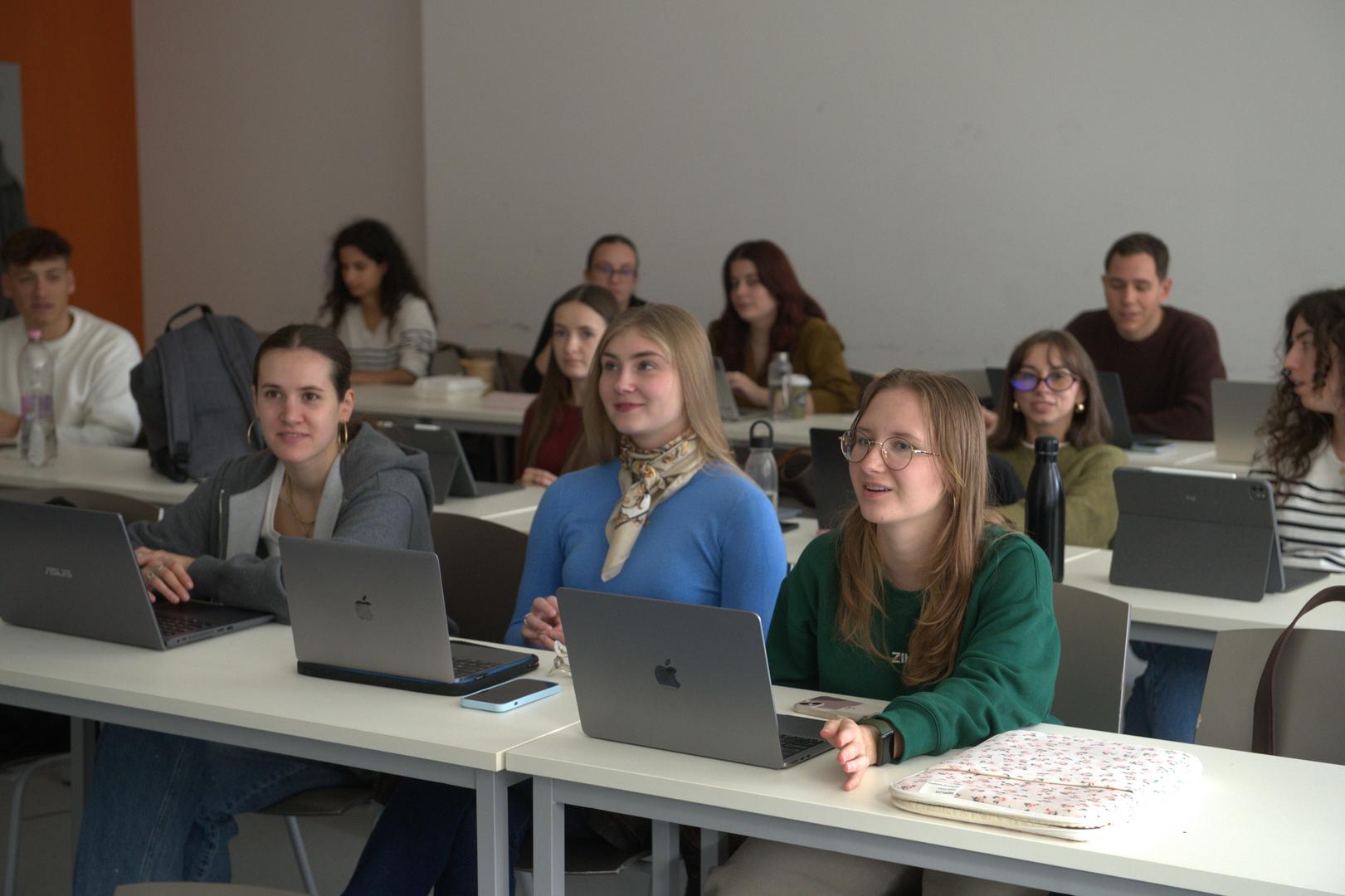
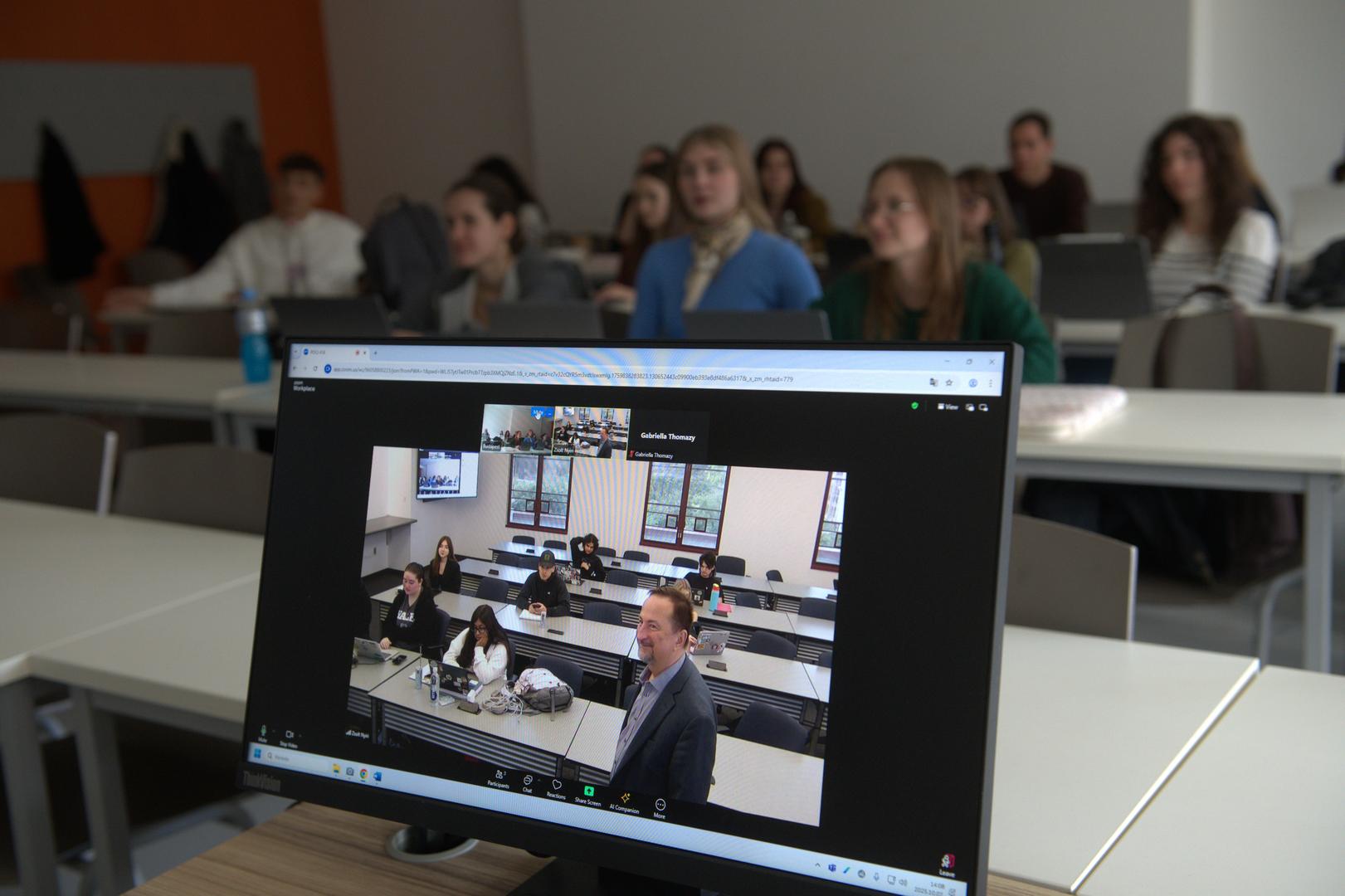
China's place in the emerging world order, the role of artificial intelligence in shaping the future, the Russian-Ukrainian war, the new US-administration or the German-French leading role in the EU. These are some of the hot topics covered in the joint diplomacy course offered by Montclair State University (MSU) Political Science and Law and Ludovika – University of Public Service, Faculty of Public Governance and International Studies. As part of the course, students from both universities regularly join online classes at the same time, give each other short news summaries of events since the last session, listen to interesting and useful lectures, and work on joint projects. We asked Zsolt Nyiri, one of the course leaders and lecturers, who is an associate professor at the American partner university, about this pioneering initiative.
„In February 2025, when Brigadier General László Christián, former vice-rector of Ludovika, was staying in Denver, USA, as a Fulbright scholar, we invited him to our university to give lectures to our students as a visiting professor," recalled Zsolt Nyiri, but even before that, there was already a connection between the two universities, with Zsolt Nyiri and Tony Spanakos visiting Ludovika. State universities, with a focus on public service and the common good – László Christián and Jonathan G.S. Koppell, president of MSU, quickly found common ground during talks held while an official visit, and their mutual agreement was confirmed in June 2025 with a cooperation agreement at the Ludovika Campus. One of the most important elements of the memorandum signed by Gergely Deli and Jonathan G.S. Koppell is the e-Diplomacy course launched in the fall, but in the future, the institutions may also accept exchange students from their partner and are considering joint research projects.
The course, called Area Studies – Diplomacy in Hungary, is called Transatlantic Relations: Common Challenges in Europe and the USA overseas and is aimed at senior political science students. „As the title of the course suggests, we deal with important and timely topics, as Trump's presidency has completely changed the United States' attitude towards supranational institutions such as NATO and the European Union. That is why I believe it is important for students from both continents to get to know each other and think together. Everyone's opinion is important; it cannot be left to the political elite alone to determine what happens in the world; students' opinions must also shape politics and diplomacy,” says Zsolt Nyiri, who is also involved in public opinion polling and combines teaching and research thanks to the course.
At Ludovika, Péter Krisztián Zachar, Vice Dean for International Affairs at FPGIS, is the course leader, and first-year students of the Master's program in International Public Service Relations are eligible to apply. The students are extremely diverse in terms of nationality, and they practically represent their own countries during the course, as they bring their perspectives to the classroom, but they are also interested, attentive, and active. Classes always begin with a short, impromptu press conference held by the students themselves, where they present and discuss current news stories. In addition to group assignments, the organizers consider it important to invite European and American guest lecturers who are leaders in their fields to give presentations.
The assessment method in the US is also different from what we are used to in Hungary: „During the semester, we have three assignments that are completed in mixed groups of MSU and Ludovika students, which are then presented in class; one part of this is the aforementioned press conference.” There is also a joint project during the year, the associate professor continues, in which the students recently had to present four countries, imagining themselves in the role of an advisor to the US president and presenting to him before a visit to Europe. What are the common challenges with the host country, what are the points of agreement, how can relations between the two countries be improved, he explains. At the end of the semester, students will be given a simulation task in which they will have to solve a problem, such as bringing the Russian-Ukrainian war to a successful conclusion. The more than thirty students in the course will receive their grades during the exam period based on the evaluation of the three assignments. „In addition to the subject matter, it is of course extremely important to know how to communicate with people from other cultures and how to manage time differences, as these are important skills for anyone who will be working in diplomacy, where they will encounter these issues on a daily basis,” emphasized Zsolt Nyiri.
Text: Dénes Szilágyi, FPGIS International Division
Photo: Dénes Szilágyi