Order-1.jpg)
Order-2.jpg)
Order-3.jpg)
Order-4.jpg)
Order-5.jpg)
Order-6.jpg)
Order-7.jpg)
Order-8.jpg)
Order-9.jpg)
Order-10.jpg)
Order-11.jpg)
Order-13.jpg)
Order-14.jpg)
Order-15.jpg)
Order-16.jpg)
Order-17.jpg)
Order-18.jpg)
Order-19.jpg)
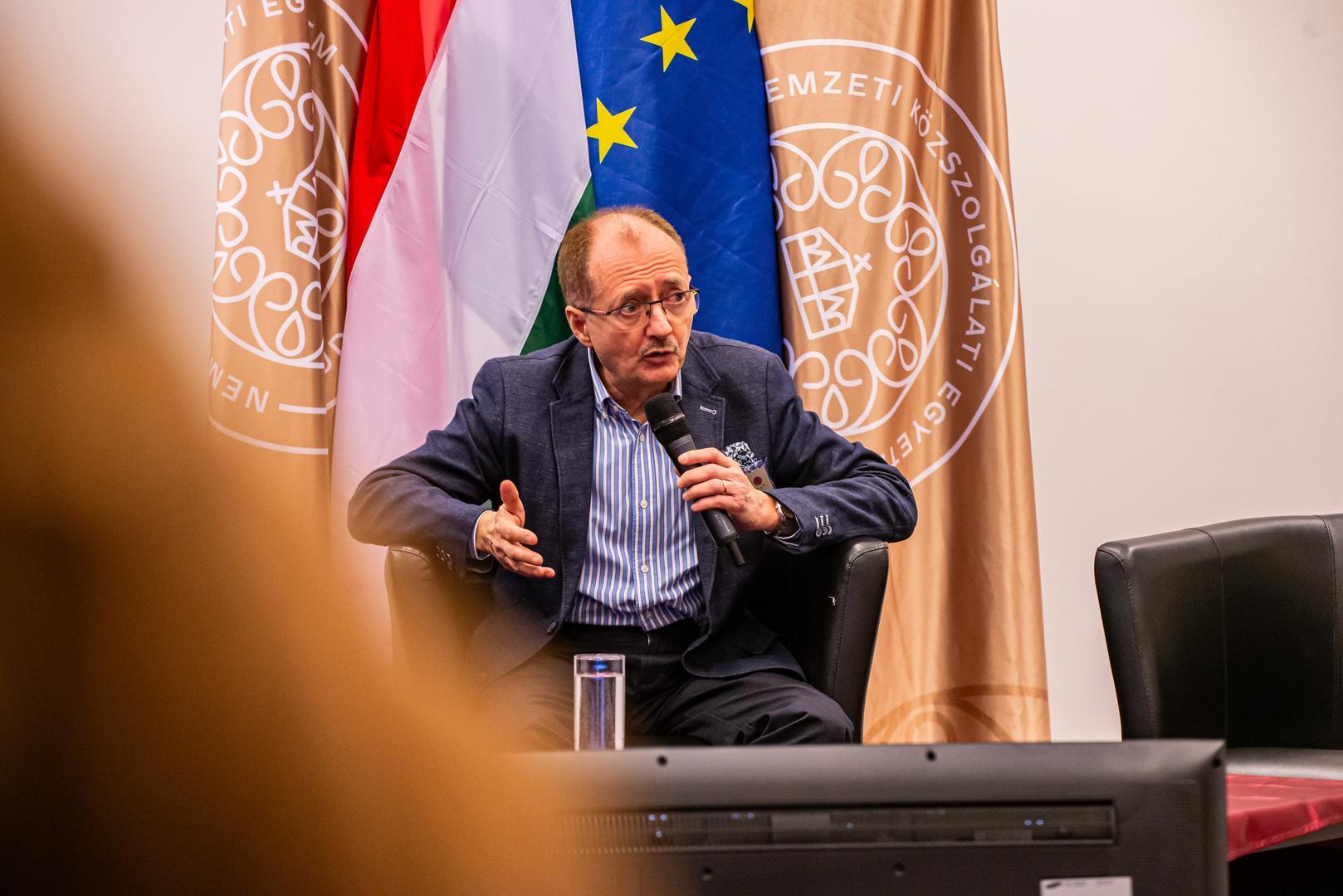
On December 5–6, the Faculty of Public Governance and International Studies at the Ludovika University of Public Service teamed up with the Khayrion organization to host a high-level international conference: “Transiting MENA (Dis-)Order: Political, Social and Economic Impacts.”
The two-day event took a deep dive into the geopolitical, economic, and security challenges of the MENA region (Middle East and North Africa), exploring what the future might hold for one of the world’s most turbulent yet fascinating zones.
In her opening speech, Professor Erzsébet N. Rózsa of the International Relations and Diplomacy Department (FPGIS) highlighted the essential role of the event within Central Europe’s academic landscape, especially for researchers focusing on the Middle East. She pointed to today’s burning issues: political transitions, social movements, wars, threats, and economic transformations — along with climate change and drought affecting North Africa and Iran. “We are trying to examine these and other critical issues, such as political change, social consequences, economic reforms and sustainable growth,” she emphasized.
Katarína Hildebrand, Director of Khayrion, underlined that the organization is now considered a regional-level partner. This was the second major international scientific event co-organized jointly by Khayrion and a renowned Central European institution. The aim? To bring together leading experts from across various fields of MENA research — especially from the V4 region — to enhance scientific cooperation and strengthen our countries’ presence in international MENA studies. She also noted that the conference welcomed not only established researchers but up-and-coming young professionals as well.
A lively roundtable followed, featuring James M. Dorsey (joining online), György Busztin, and Katarína Hildebrand. Dorsey pinpointed several key forces shaping the region: shifts in the US–Israel relationship, which heavily influence Gaza’s future; the repositioning of Saudi Arabia; and significant internal transformations in Iran. The experts also addressed the million-dollar question: is there any realistic solution to the conflict in Gaza?
Moderated by Erzsébet N. Rózsa, the first panel zoomed in on MENA–EU ties. Dr. Fabio Coriolano (Warsaw School of Economics) discussed his research on the development of economic relations between the EU and the Mediterranean. His key takeaways were: Europe remains the Mediterranean’s top trading partner. Between 2000–2010, economic growth did not lead to higher productivity, while unemployment stayed high — a dynamic he believes contributed to the Arab Spring. After Central and Eastern Europe joined the EU, the Mediterranean region increasingly became a border zone to be protected.
Next, György Busztin, former ambassador and Khayrion research fellow, addressed how Europe might restore its credibility in the Middle East. He spoke about the post-war environment, the role of the two blocs, Israel, and US–UK influence. He also warned of insufficient cultural sensitivity: “Europe’s reputation in the MENA region has been tarnished,” he stated, attributing this to European division and political inconsistencies.
Then came Jakub Horváth from Comenius University in Bratislava, who explored the presence of Turkey and Saudi Arabia in Bosnia and Herzegovina. Both states, he noted, have powerful roles in the country rooted in religion and shared history. He highlighted Turkey’s intense political involvement: “The Turkish president has visited Bosnia three times over the past five years.” He also mentioned the King Fahd Mosque — one of the Balkans’ largest mosques — built with Saudi Arabian support.
Researcher Reza Abbasi presented on intelligence agencies in the MENA region and their relation to international law. He examined how intelligence services shape international law and foreign policy, and how intelligence operations can function without violating international legal norms or UN principles. His aim: to help policymakers navigate the legal and ethical boundaries of intelligence work.
Omid Hedayati, PhD student at the University of Szeged, analyzed the EU’s role in the U.S.–Iran confrontation. He explained: “Europe tried hard to preserve the Joint Comprehensive Plan of Action, but after the so-called snapback mechanism, the EU aligned with the United States, which was a strategic shift between 2018 and 2025.” He also noted: China continues to purchase Iranian oil; Russia cooperates with Iran strategically. For Europe, he argued, becoming a stronger actor within the transatlantic alliance will be essential.
The discussion from the floor brought up issues such as: Iran’s growing presence in the Balkans; the security implications of artificial intelligence; major economic investments flowing into the region.
Throughout the remainder of the conference, distinguished experts tackled a wide range of issues, including: the role of culture, norms, and society in shaping foreign policy; Islamism’s place in governance, security, and diplomacy; MENA geopolitics in the emerging world order; the Syrian conflict’s regional reach and diplomatic-economic dimensions; the Israeli–Palestinian question; and the current situation in Afghanistan under Taliban rule.
Text by: Éva Harangozó and FPGIS International Division
Photos by: Márk Benjámin Mészáros