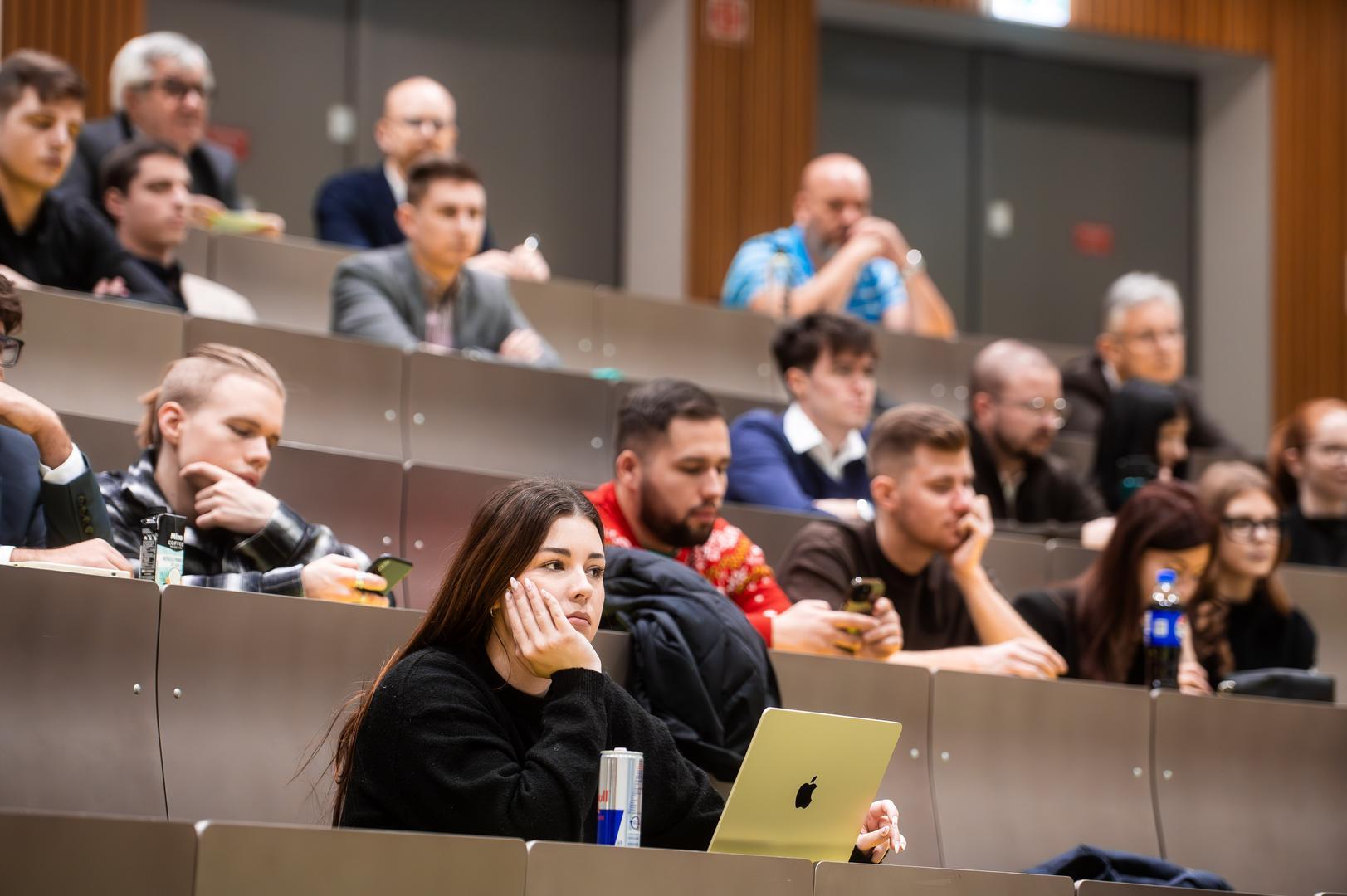
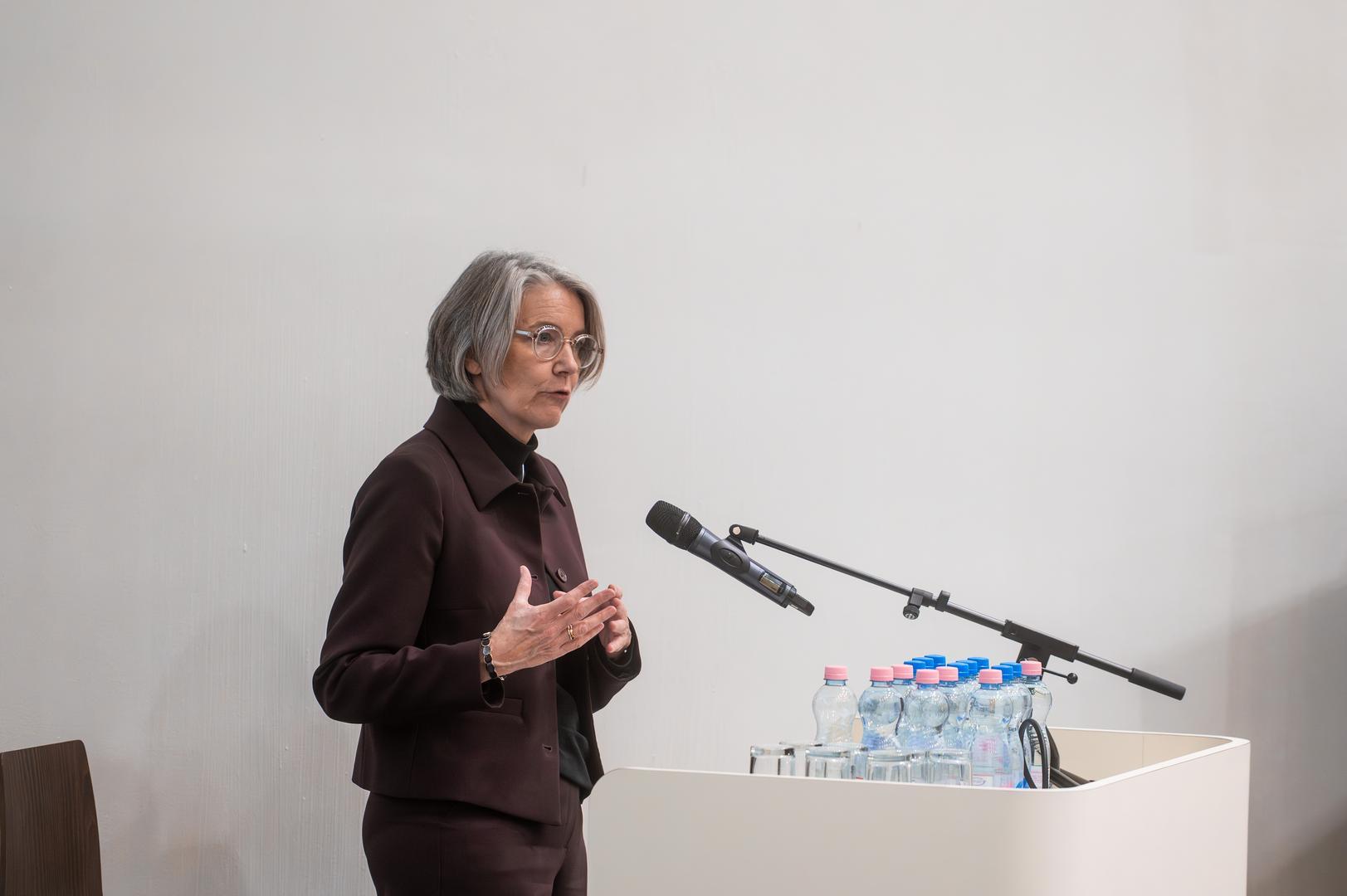

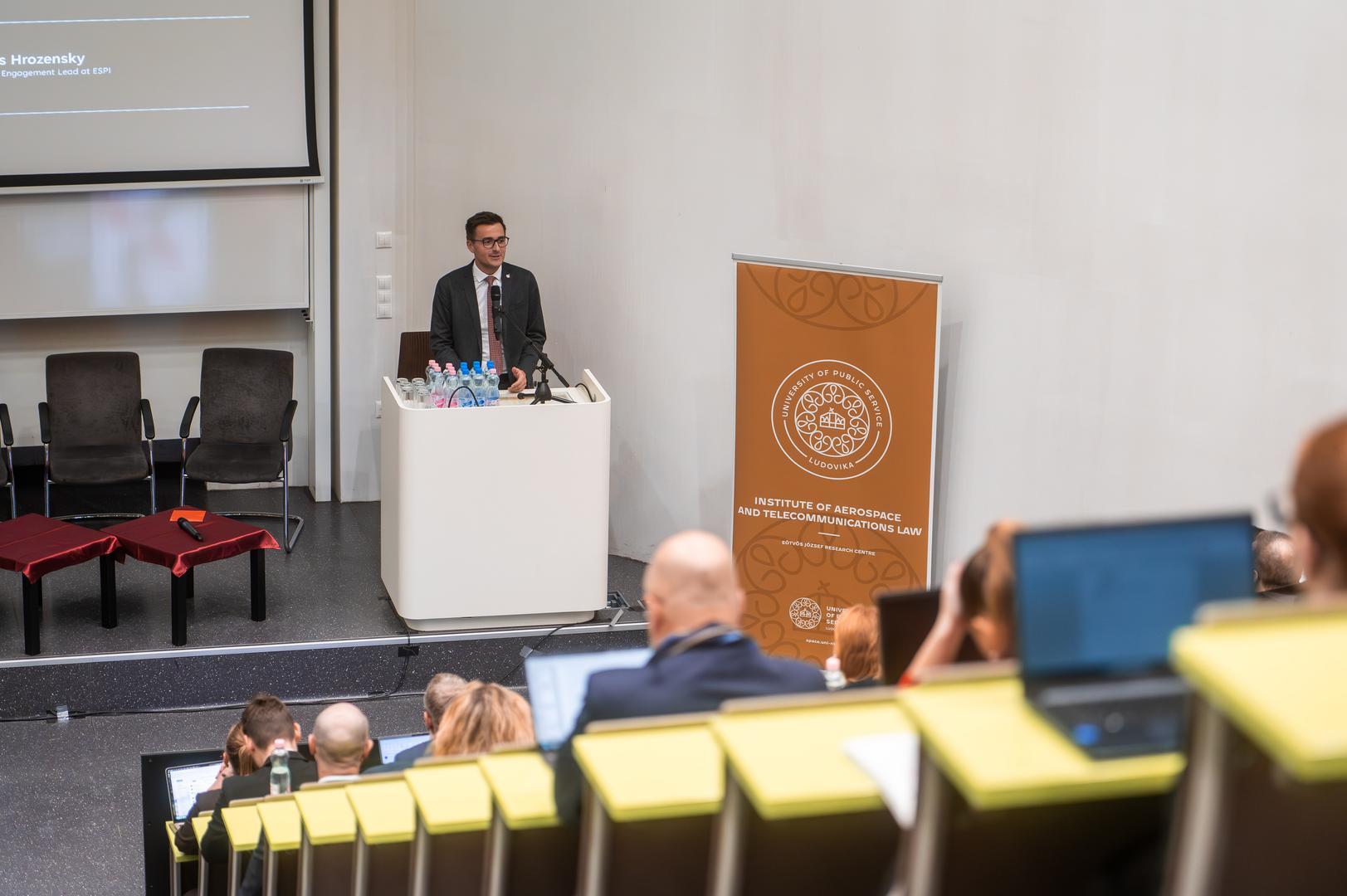
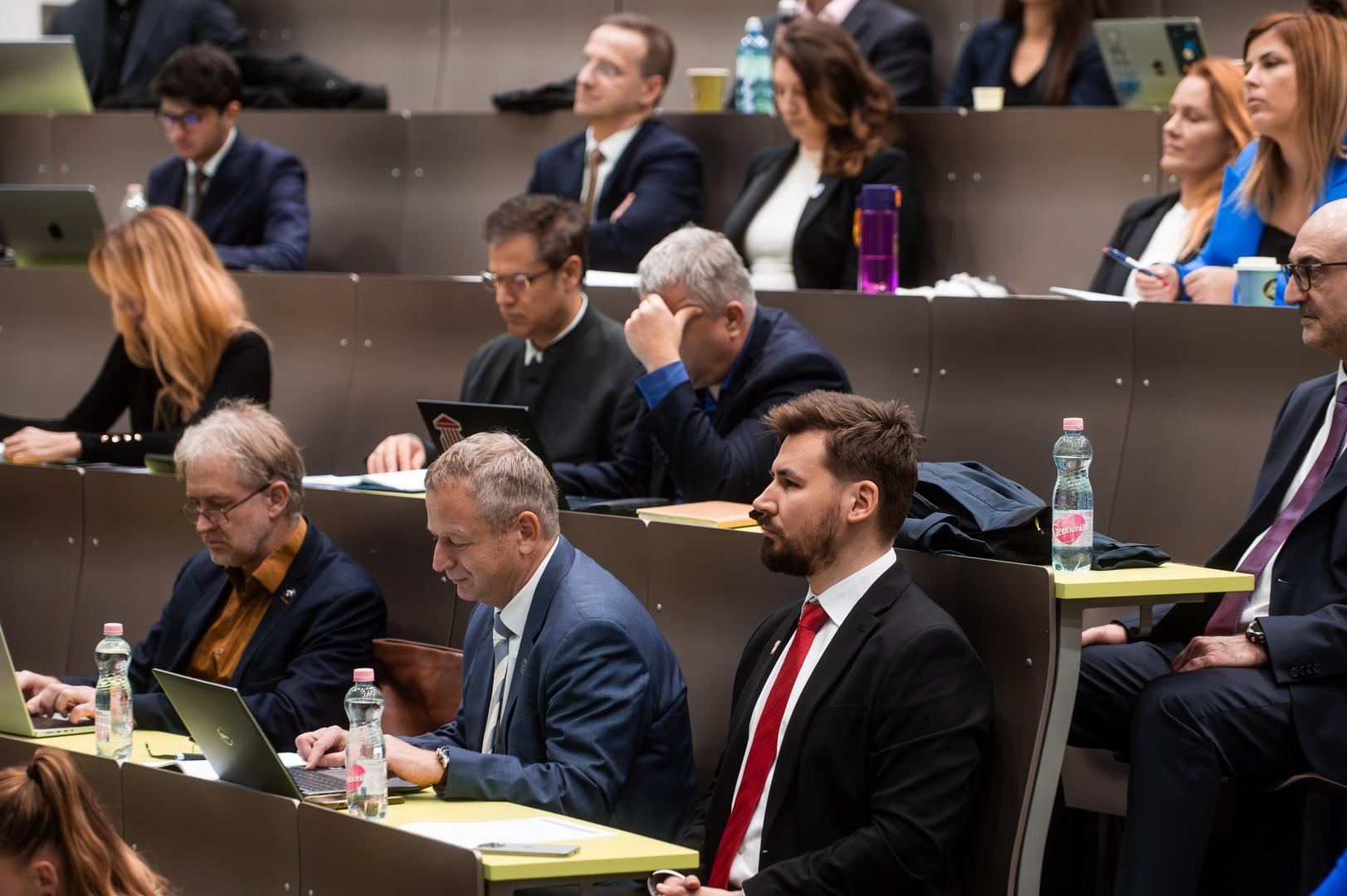
The Faculty of Public Governance and International Studies (FPGIS) of the Ludovika University of Public Service (LUPS), the Telecommunications, Air and Space Law Research Institute, and the Hungarian Astronautical Society jointly organized the 3rd Budapest Space Policy Conference titled Europe’s Space Ambitions in an Era of Change, held at the university’s Education Centre on 4 December. At the event, experts, researchers and industry stakeholders discussed the legal, security and technological challenges facing European and global space activities.
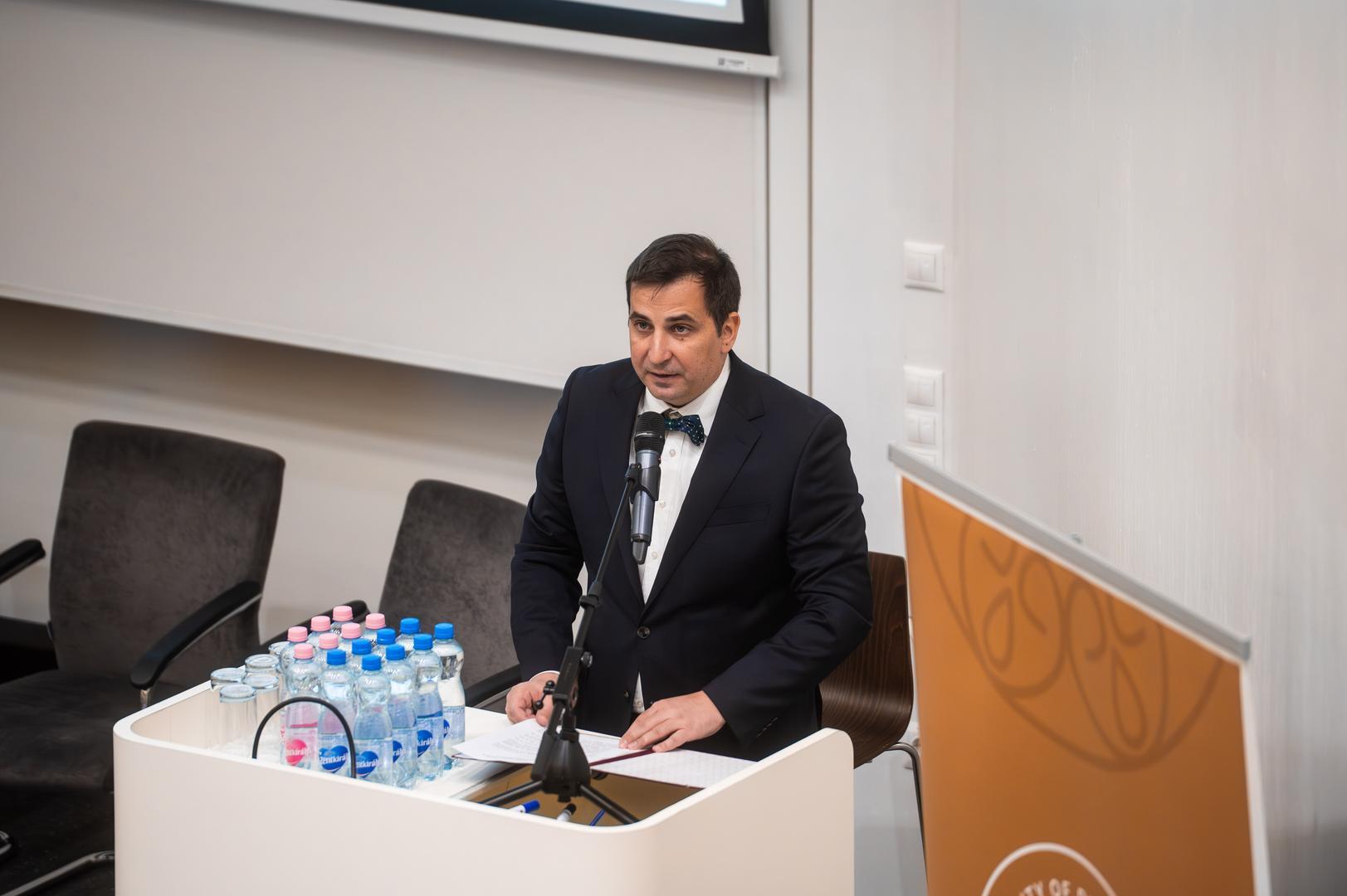
Gergely Deli, Rector of LUPS, welcomed the domestic and international participants. “The mission of our university is to operate at the intersection of science and public policy, where different fields and ideas can meet,” he emphasized. He highlighted that space is one of the most interdisciplinary areas, where cooperation between engineers, lawyers and decision-makers is essential. Speaking about the transformation of European space policy, he underlined: “Europe’s strategic autonomy, technological competitiveness and regulatory vision are being put to the test today.” He mentioned the significance of the EU Space Act, which aims to create a stable and predictable environment and enhance the safety of space activities.
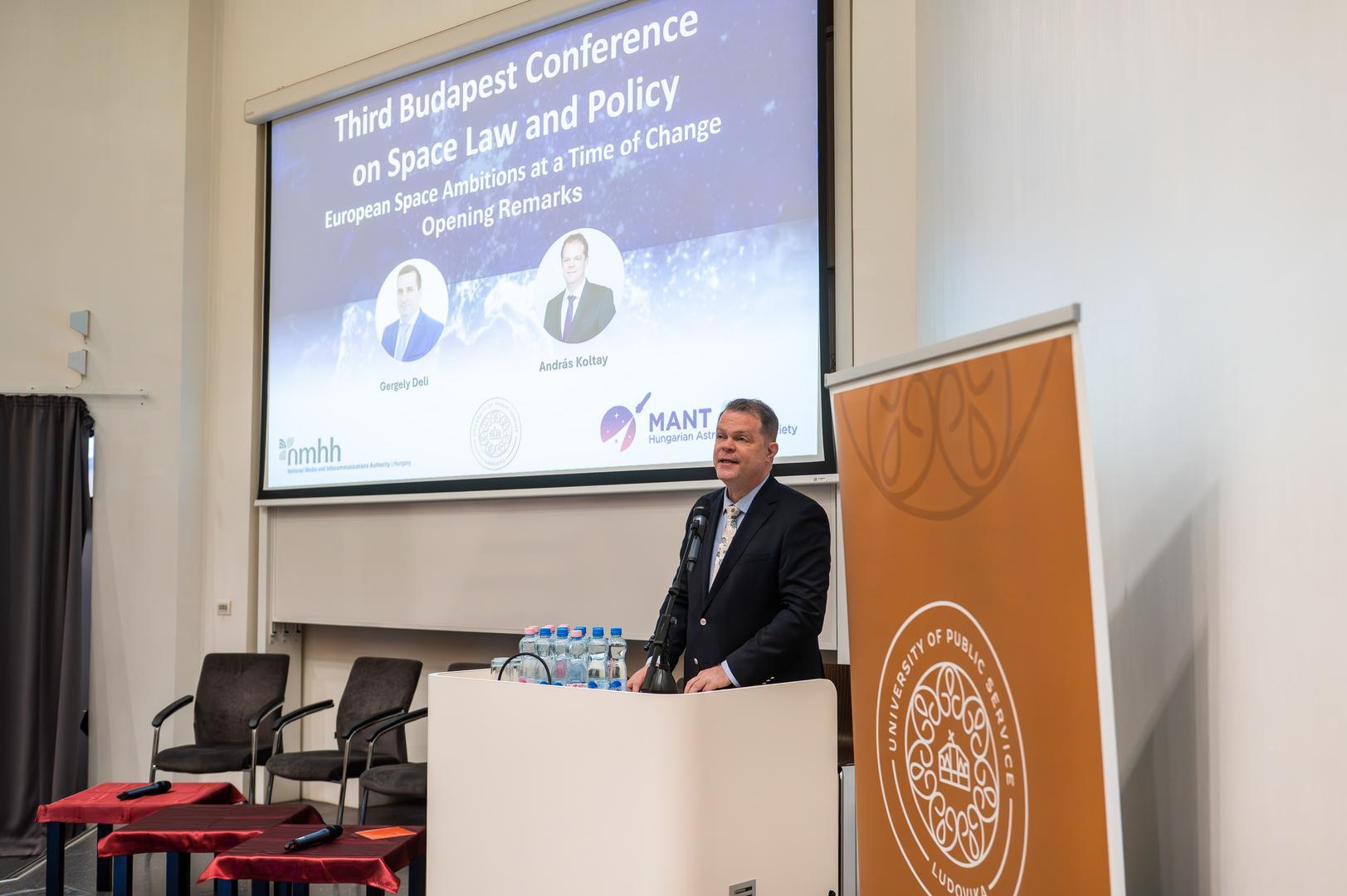
András Koltay, President of the National Media and Infocommunications Authority (NMHH), spoke in his welcome address about the new space era, highlighting the importance of space communications and spectrum regulation. He pointed out that satellites and space infrastructure form the foundation of modern society. He emphasized the significance of international and domestic cooperation, as well as education and talent development, and considered the professional dialogue and the trilateral cooperation between universities, the state and industry to be essential.
After the welcome speeches, plenary presentations followed. Marjolijn van Deelen, the EU Special Envoy for Space at the European External Action Service, focused her presentation on key issues of European space security and defence. She pointed out at the beginning: “Space is not only about exploration and astronauts, but very much about our everyday life.” She emphasized modern societies’ dependence on space. She explained that the EU Space Strategy for Security and Defence is built on several pillars: joint threat assessment, increasing the resilience of space systems, rapid and decisive response to threats, and better use of space capabilities for defence purposes.
Tomas Hrozensky, representing the European Space Policy Institute (ESPI), spoke about whether Europe can be considered a true space power. He emphasized that ESPI is an independent international think tank whose goal is to support European space policy, advise decision-makers and examine the efficiency of investments in space. He described how ESPI attempted to measure Europe’s capabilities and autonomy on the basis of more than 90 indicators: according to this, Europe is not considered a full-fledged space power; shortcomings include the lack or low level of certain key capabilities, limited strategic autonomy (dependence on components and external technologies), and decision-making constraints due to the sovereignty of EU member states. In conclusion, Europe must become a space power, but this requires greater autonomy, a coordinated European strategy, adequate industrial capacity and significantly more investment.
Rosanna Deim-Hoffmann, Head of Space Law at the United Nations Office for Outer Space Affairs (UNOOSA), spoke about global space governance. She emphasized that the classical space treaties are still alive and relevant today and continue to provide a legal framework and a starting point for interpreting all new technological issues (space mining, megaconstellations, weaponization). Among the main current challenges, she mentioned great power competition and security tensions, space traffic regulation, the legal questions of space mining and resource utilization, and the fact that an increasing number of actors (states and private companies) are entering space activities.
After the plenary presentations, invited experts discussed European and transatlantic security issues in a panel moderated by Szilvia Balázs, professional lead at the Ministry of Foreign Affairs’ Department for Disarmament, Non-Proliferation, Arms Control and New Security Challenges. Julia Balm, researcher at the King’s College Freeman Air and Space Institute, spoke about the British space strategy, its challenges and alliance relations. She highlighted that the British space sector is significant but vulnerable: among other things, 90 percent of its satellite infrastructure is foreign-owned and it lacks a coherent, long-term national vision.
Heinrich Kreft, Programme Director of the German Federal Foreign Office’s International Diplomacy Academy, outlined the historical development, strategic transformation and new security framework of German space policy. He reminded listeners that due to strict restrictions after World War II, German space activity was limited to civilian purposes. The first national security strategy appeared in 2021, in which little was said about space. Although Germany remains cautious, it increasingly links defence and space, aiming to build capacities aligned with NATO and EU goals.
Don Koulaouzos, Managing Director of Skytrek Limited, presented how society is critically dependent on satellite systems, and how this dependence increasingly poses security risks. Space programmes worldwide are growing rapidly: out of 195 countries, eighty now have a space programme, including African and Asian states. Nevertheless, few countries produce fully autonomous systems. He mentioned the Hungarian HUSAT (Hungarian Satellite) programme as a positive example.
András Edl, researcher at the LUPS Telecommunications and Space Law Research Group, explored the Chinese approach and great power logic. China has recognized that the United States is excessively dependent on satellites. Since Starlink has disrupted the strategic balance, China perceives every American step as a threat, which may trigger a dangerous spiral.
The second panel – which examined the EU Space Act from an academic perspective – was chaired by Gábor Sulyok, Professor of International Law at Széchenyi István University. Philippe Achilleas, Professor of International Law and Director of the Space and Telecommunications Law Institute at Université Paris-Saclay, reviewed the details of the EU Space Act. Balázs Bartóki-Gönczy, Scientific Vice-Dean of LUPS FPGIS and Director of the Telecommunications, Air and Space Law Research Institute, examined the EU Space Act and international space law, focusing on whether the European framework is compatible with international space treaties. Zsolt G. Pataki, policy analyst at the European Parliamentary Research Service (EPRS), analyzed how the EU Space Act should prepare for the challenges of the coming decades from a futures-studies perspective. Accordingly, he outlined several strategic approaches. In his view, the EU will remain sovereign in space only if it avoids fragmentation and vulnerability.
Csaba Krasznay, Associate Professor at the LUPS FPGIS Department of Cybersecurity and e-Government, focused his presentation on the fact that the cybersecurity of space systems is no longer a theoretical question but a wartime reality. He emphasized that the protection of space systems is part of hybrid warfare, just as the protection of critical terrestrial infrastructures. He reminded listeners that at the outbreak of the Russia–Ukraine war in 2022, a Russian cyberattack targeted the Viasat satellite system, which caused problems not only in Ukraine. “For the first time, we clearly saw that cyberspace and space form a connected theatre of operations,” he said. He added that an attack against a satellite can cause a global chain reaction.
The third panel focused on the industry perspectives of the EU Space Act, chaired by Róbert Szuchy, law professor and Vice-Rector of Károli Gáspár University (KRE). The panel showcased several industry viewpoints: Alicia Brown, Director of the U.S. Commercial Space Federation, joined online and assessed the EU Space Act from the perspective of the American space industry. Chehineze Bouafia, Satellite and Telecommunications Regulatory Lead of the Eutelsat Group, presented the experiences and expectations of a GEO–LEO satellite operator. Jordi Casanova Tormo, representing Amazon’s Kuiper programme, spoke about how regulation can be shaped to contribute to a safe and sustainable space environment. From the Hungarian industry side, the presentation of Fruzsina Tari, Legal Lead of 4iG Space and Defence Technologies, focused on the debated legal bases and regulatory shortcomings of the current draft, emphasizing that due to the specific technological and dual-use civil–military nature of the space industry, excessive or inaccurate EU regulation is particularly sensitive.
Text: Éva Harangozó
Photo: Dénes Szilágyi